Pupil sheet · Cells under the microscope
Specialised cells and organisation — questions
Name ______________________ Date ____________
Try every question before you use a nudge. Write in full sentences where you are asked to explain.
1. state
Match each specialised cell to its job.
Write the number of the matching option.
- Moves mucus in the trachea and bronchi
- Absorbs water and mineral ions
- Photosynthesis
- Conducts electrical impulses
- Transports oxygen
- Reproduction
- Ciliated cell: ______
- Root hair cell: ______
- Palisade mesophyll cell: ______
- Neurone: ______
- Red blood cell: ______
- Sperm cell and egg cell: ______
Nudge (only if you are stuck): Think about what each cell’s special part is for: hairs, a long extension, chloroplasts, a long fibre, no nucleus, a tail.
2. state
Where do new cells come from?
Circle one answer.
- They form from food in the cytoplasm.
- They grow out of the cell wall.
- Existing cells divide into two.
- The nucleus makes a new cell inside the old one.
Nudge (only if you are stuck): Look at the root-tip picture: what are the cells with dark threads doing?
3. state / describe
Put these in order from the smallest level of organisation to the largest: organ, cell, organism, tissue, organ system.
Write the number of each step in order.
- Organ
- Cell
- Organism
- Tissue
- Organ system
- Smallest: ______
- Second: ______
- Third: ______
- Fourth: ______
- Largest: ______
Nudge (only if you are stuck): Which is a group of cells? Which is a group of tissues?
4. explain
Explain how two features of a red blood cell help it transport oxygen.
Feature 1 and how it helps
Feature 2 and how it helps
Nudge (only if you are stuck): What does it contain a lot of, and what is missing that leaves more room?
5. identify
Match each example to its level of organisation.
Write the number of the matching option.
- Cell
- Tissue
- Organ
- Organ system
- Organism
- One root hair cell: ______
- A layer of ciliated cells lining the trachea: ______
- The heart: ______
- The heart, blood vessels and blood working together: ______
- A rabbit: ______
Nudge (only if you are stuck): Ask what each one is made of: one cell, many similar cells, several different tissues, several organs, or a whole living thing?
6. describe / explain
This drawn view shows the tip of a growing onion root. In a few cells the genetic material is packed into dark threads. (a) What are these cells doing? (b) Explain why you find dividing cells in a root tip.
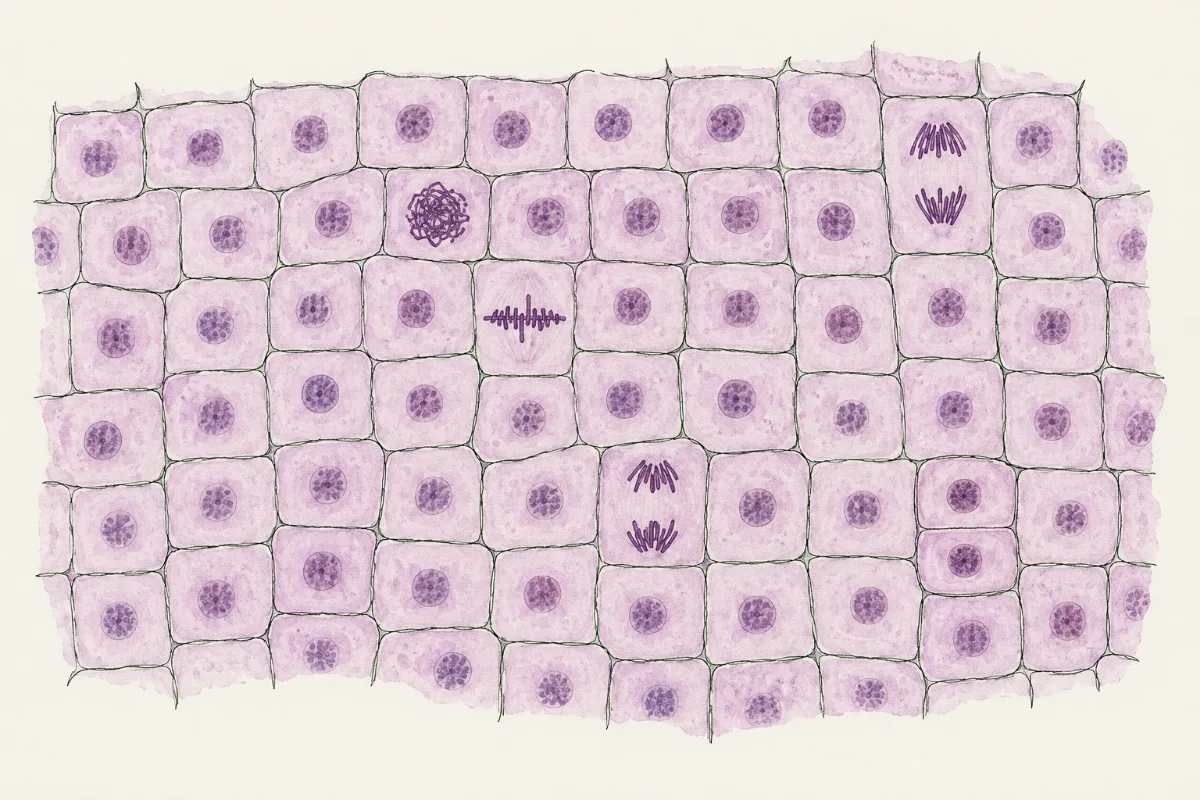
(a) What the cells are doing
(b) Why they are found in a root tip
Nudge (only if you are stuck): What happens to the genetic material just before a cell splits? And what is a root tip doing all the time?
7. suggest / explain
Cells lining the small intestine have a surface folded into thousands of tiny projections. (a) Suggest the job of these cells and explain how this feature helps. (b) Thousands of these cells sit side by side as one layer lining the intestine. Which level of organisation is this layer?
(a) Job and how the folds help
(b) Level of the layer of cells
Nudge (only if you are stuck): Compare with the root hair cell: what does a big surface help a cell do? For (b): many similar cells working together make…?