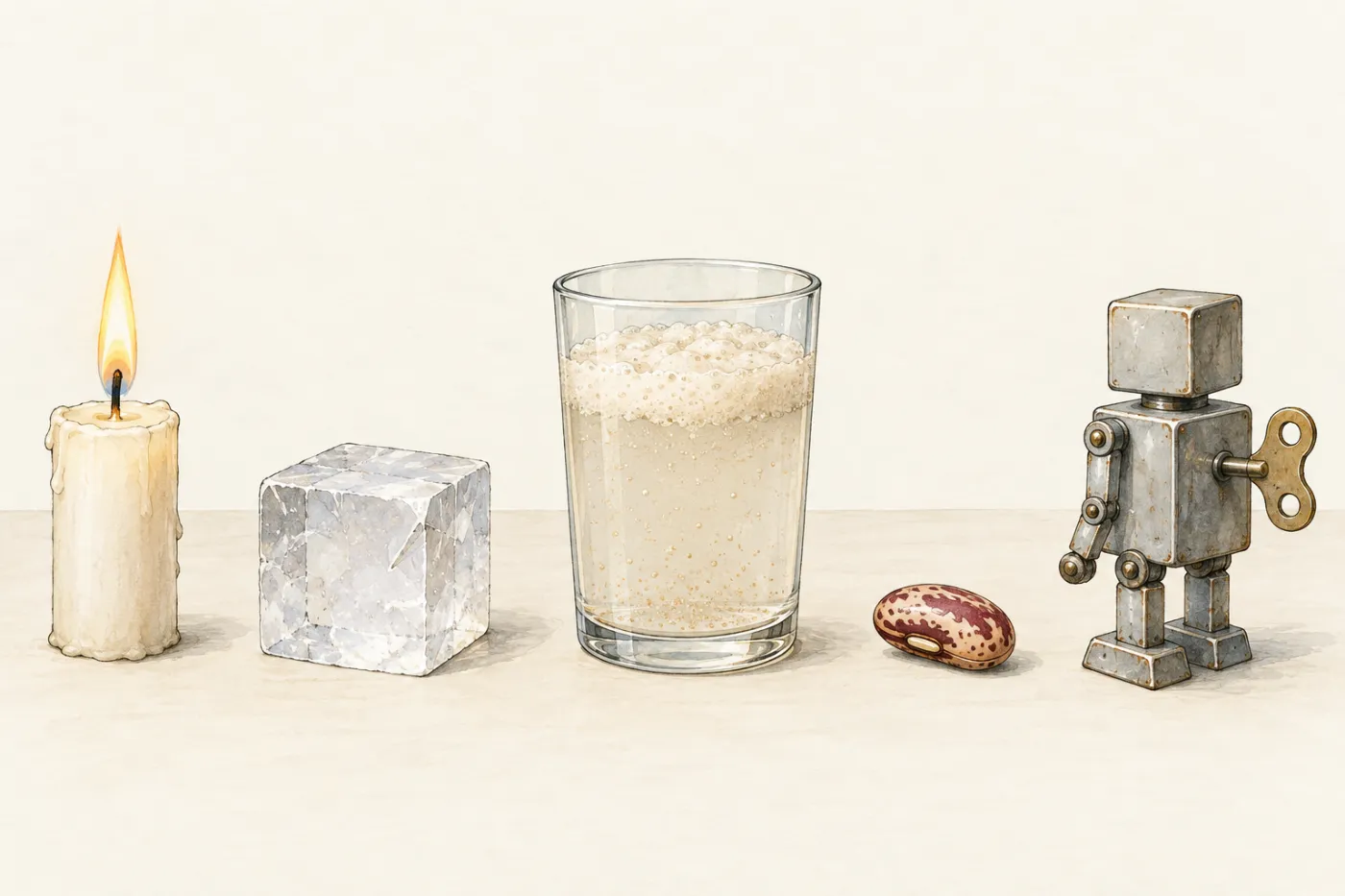
Five things stand in a row on a bench: a burning candle, a big salt crystal, a glass of sugar water with yeast in it, a dry bean and a wind-up toy robot. Which of them are alive? The candle flame flickers and takes in oxygen from the air. Last week the crystal got bigger in a dish of salty water. The robot walks across the bench. Each of them does something a living thing does. Yet only two of the five are alive, and one of those two looks as if it is doing nothing at all.
 (enlarge)
Seven characteristics
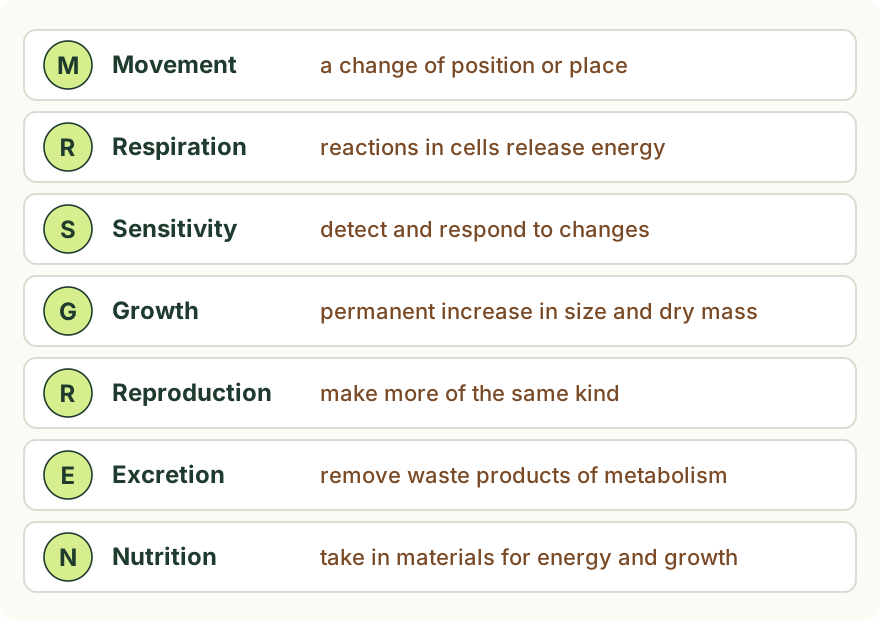
Biologists do not decide by one clue. Living things, organisms, show all seven of these characteristics:
- Movement: an action by an organism or part of an organism causing a change of position or place. A snail glides; a daisy closes its petals at night.
- Respiration: the chemical reactions in cells that break down nutrient molecules and release energy for metabolism (all the reactions that happen in the cells).
- Sensitivity: the ability to detect and respond to changes in the internal or external environment. You pull your hand from a hot pan; a shoot bends towards the light.
- Growth: a permanent increase in size and dry mass (the mass left when all the water is removed).
- Reproduction: the processes that make more of the same kind of organism.
- Excretion: the removal of the waste products of metabolism and substances in excess of requirements (more than the body needs). Carbon dioxide made in respiration is one of these waste products.
- Nutrition: the taking in of materials for energy, growth and development.
The first letters spell MRS GREN, a name that helps you remember all seven.
 (enlarge)
Trap: "Respiration is breathing." Breathing moves air in and out of the lungs. Respiration is the chemical reactions inside every living cell that release energy from nutrients. A tree respires but does not breathe.
Testing the five things
Now test each thing on the bench against all seven characteristics, not just one. (A seed germinates when it starts to grow a root and a shoot.)
| Moves | Respires | Senses and responds | Grows | Reproduces | Excretes | Takes in nutrients | |
|---|---|---|---|---|---|---|---|
| Candle flame | flickers | no cells | no | no | no | no | no |
| Salt crystal | no | no cells | no | gets bigger, but not alive | no | no | no |
| Wind-up robot | yes | no cells | no | no | no | no | no |
| Yeast | inside its cells | yes | yes | yes | yes, by budding | yes | yes, sugar |
| Dry bean | when it germinates | yes, slowly | when it germinates | when it germinates | grows into a plant that makes seeds | yes | from its food store, then by making its own food |
The candle uses oxygen and gives out carbon dioxide, but that is burning, not reactions in cells: it has no cells at all. The crystal does get bigger, but only because more salt comes out of the solution onto its surface; it takes nothing in to use, and it cannot make new crystals of its own. The robot moves, until its spring runs down. Each of the three shows one or two characteristics at most.
The yeast shows all seven. It takes in sugar (nutrition), uses it in respiration and releases carbon dioxide gas, which makes the foam (excretion). Yeast cells grow and bud off new yeast cells (growth and reproduction), and they respond to the sugar around them. A yeast cell cannot swim, but parts inside it move: when it buds, a copy of its nucleus moves into the new bud. The dry bean is the surprise. It seems to do nothing, but its cells are alive and respire very slowly. Give it water and warmth, and in a few days a root and a shoot appear: it grows, moves its root down and its shoot up, and becomes a plant that will make its own seeds.
Trap: "The flame is alive because it uses oxygen and grows." A flame shows a few of the characteristics, and none of them by reactions in cells. Living organisms are made of cells and show all seven.
Trap: "Faeces are excretion." Faeces are mostly food that was never digested and never entered the body's cells, so they are not waste of metabolism. Removing them is called egestion. Excretion removes waste made by reactions in cells, such as carbon dioxide and urea (a waste substance made in the body and removed in urine).
Does every single organism do all seven? Not always. A mule (you meet it in part 3) can never have young, but it is alive: its cells respire, and it moves, senses, grows, excretes and feeds, like the horses and donkeys it comes from. A dry seed shows most of the characteristics only after it germinates. So the seven characteristics describe living organisms as a whole. Something that shows only one or two of them, and has no cells at all, like the flame, the crystal or the robot, is not alive.
Growth is more than getting bigger
Leave a dry bean in water overnight and it swells to twice its size. Has it grown? Not yet. All of the extra mass is water, and water can dry out again. Growth is a permanent increase in size and dry mass: the mass that is left when all the water has been removed. A bean swells by taking in water; a seedling grows by building new cells from the food it has made in its leaves.
 (enlarge)
Plants are organisms too
It is easy to think that plants do not do much. Look again. A plant moves parts of itself: leaves turn to face the light, and some flowers open in the morning and close at night. It is sensitive: a shoot detects light and grows towards it, and a root grows downwards. Its nutrition is to take in carbon dioxide, water and mineral ions and make its own food in its leaves. It respires all the time, in all its living cells. In bright light it makes food, uses the carbon dioxide from respiration to make more, and excretes the oxygen it does not need. In the dark it makes no food, so it excretes the carbon dioxide from respiration. Plants grow and reproduce, often by seeds, like the bean.
Once you know that something is alive, the next question is what it is. Part 2 shows how to name it with a key.
Key idea: Living organisms show seven characteristics: movement, respiration, sensitivity, growth, reproduction, excretion and nutrition. Something that shows only one or two of them and has no cells, such as a flame, a crystal or a machine, is not alive. Respiration is reactions in cells, not breathing; growth is a permanent increase in size and dry mass.