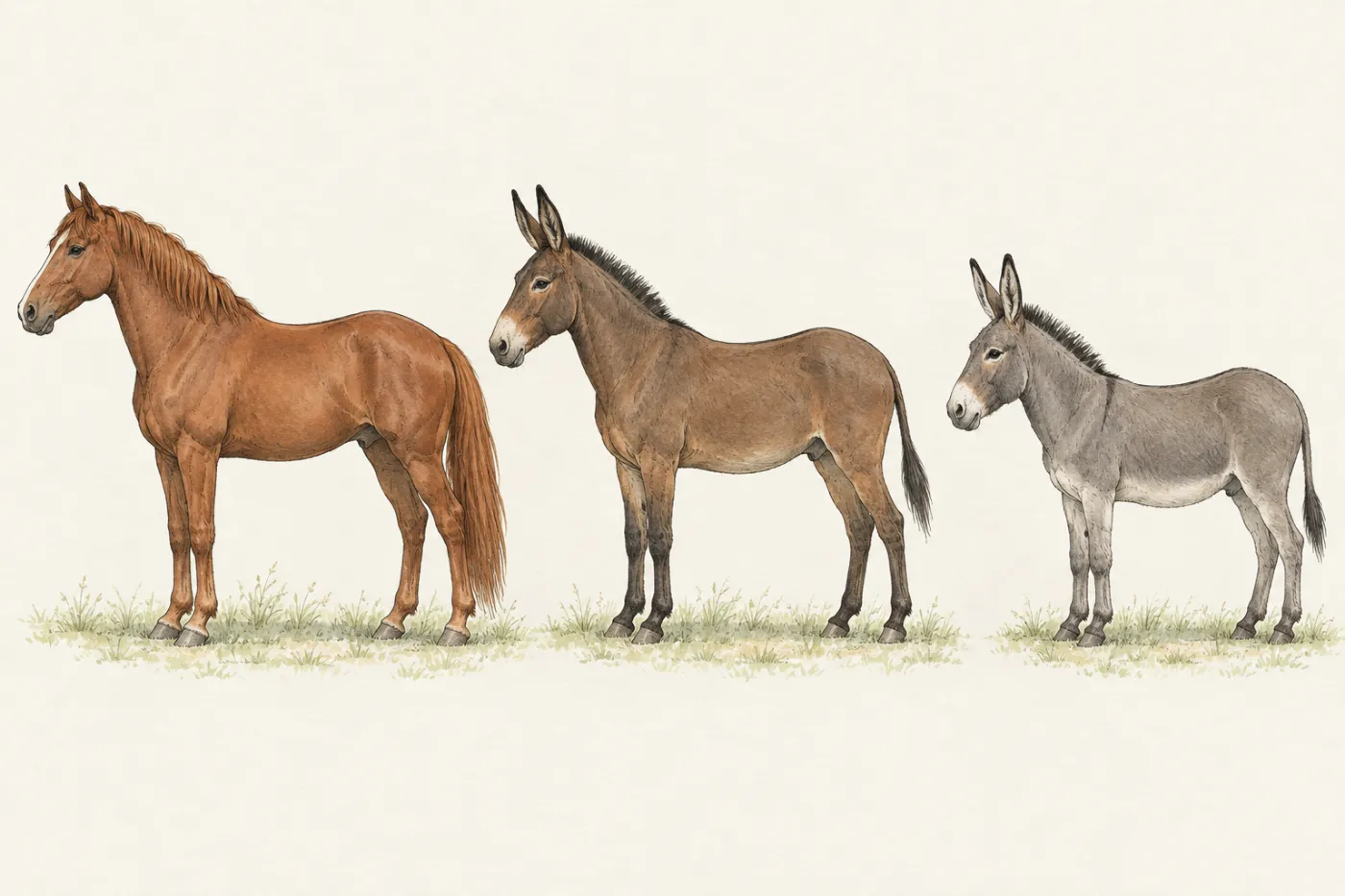
A farmer puts a male donkey in a field with a female horse. A year later a foal is born: a mule. Mules are strong, calm and sure-footed, and people have bred them for thousands of years. But a mule almost never has a foal of its own. Every new mule needs a horse and a donkey as parents. Why can't mules simply breed with each other, as horses do?
 (enlarge)
Groups of shared features
There are millions of kinds of organisms. To make sense of them, biologists classify them: they sort them into groups by the features they share. Organisms with many features in common go in the same small group; small groups that share some features go together into larger groups, and so on, up to very large groups such as the animal kingdom or the plant kingdom.
The sycamore and the field maple from the key are a good example. Their leaves look alike, with lobes spreading from one point. Their leaves grow in opposite pairs on the twig, and both trees make winged fruits that grow in joined pairs and spin like helicopters as they fall. So biologists put them in one small group, together with about a hundred other kinds of maple tree.
What is a species?
The smallest group used in classification is the species. A species is a group of organisms that can reproduce to produce fertile offspring: young that can themselves have young.
Two horses have a foal, and when that foal grows up it can have foals of its own. Horses are one species. A horse and a donkey can mate and have a mule, but the mule is infertile: it cannot reproduce. So horses and donkeys are two different species, even though they look alike and can mate.
Trap: "Two animals that can mate and have young must be the same species." The young must be fertile. A horse and a donkey have young, but mules are infertile, so horses and donkeys are different species.
A name in two parts
Common names cause confusion. In Britain, "sycamore" is the tree in the key; in North America, "sycamore" is the name of a completely different tree, a kind of plane tree. One tree can have dozens of names in different languages. So scientists use the binomial system: an internationally agreed system in which the scientific name of an organism is made up of two parts, showing the genus and the species.
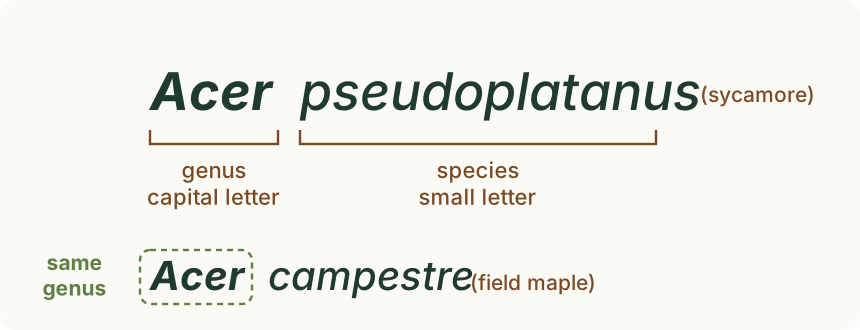
The first part is the genus, a group of closely similar species. The second part names the species within that genus. The sycamore is Acer pseudoplatanus and the field maple is Acer campestre: two species in the same genus, Acer, the maples. The name is the same all over the world.
 (enlarge)
Scientific names follow simple rules: the genus starts with a capital letter, the species part starts with a small letter, and the whole name is printed in italics (underlined when you write it by hand). Your own species is Homo sapiens.
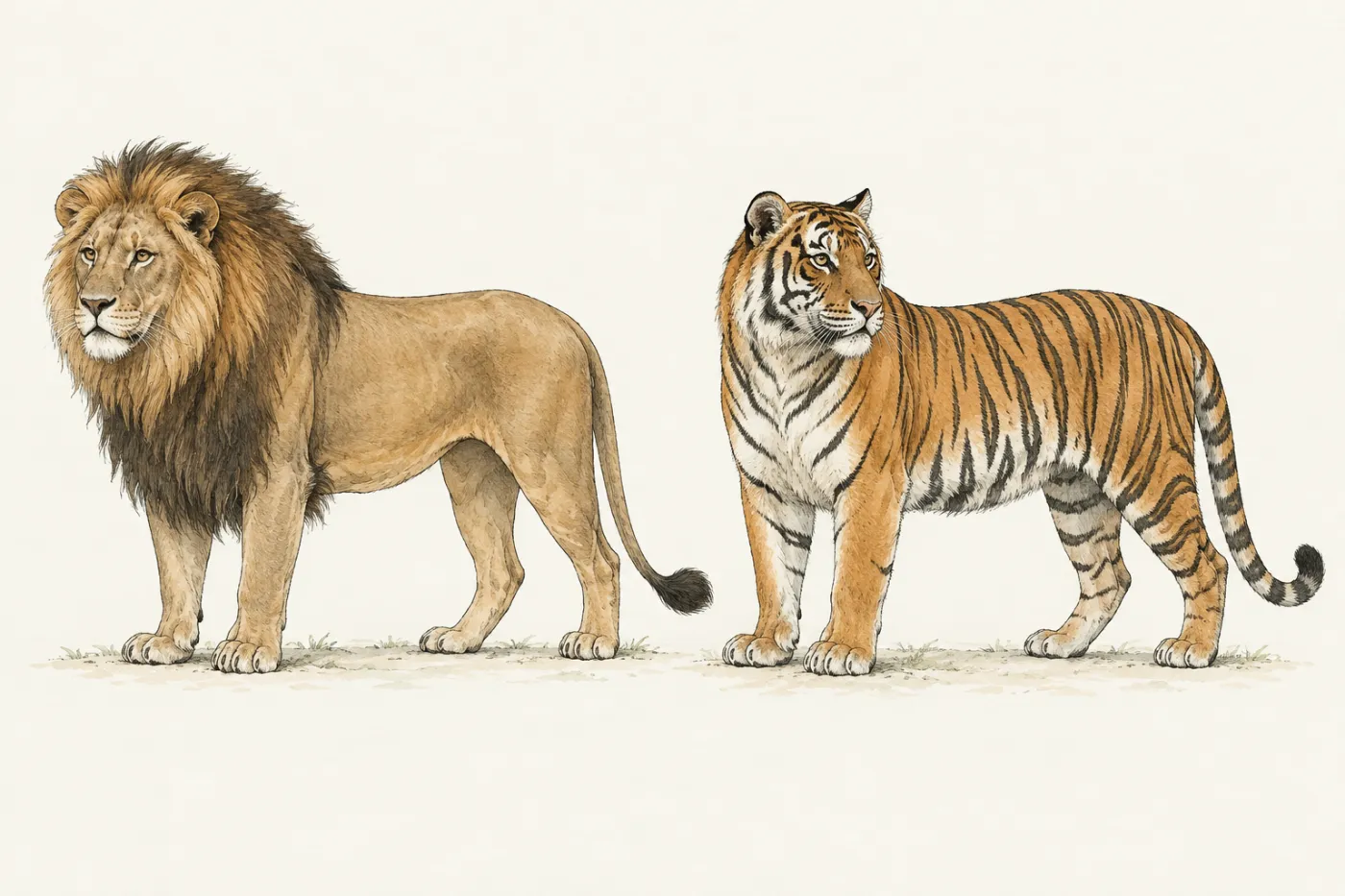
The lion and the tiger look quite different, one with a mane and one with stripes. But look past the fur: they have the same powerful build, big paws and long tail, the same kind of skull and teeth, and both can roar. Both are in the genus Panthera: the lion is Panthera leo and the tiger is Panthera tigris.
 (enlarge)
Trap: "The second word alone is the name of the species." campestre just means "of the fields" and is used in the names of plants in other genera too (genera is the plural of genus). The species is named by both words together: Acer campestre.
Supplement: classification and evolution
This section is Supplement content (syllabus 1.2.5–1.2.7).
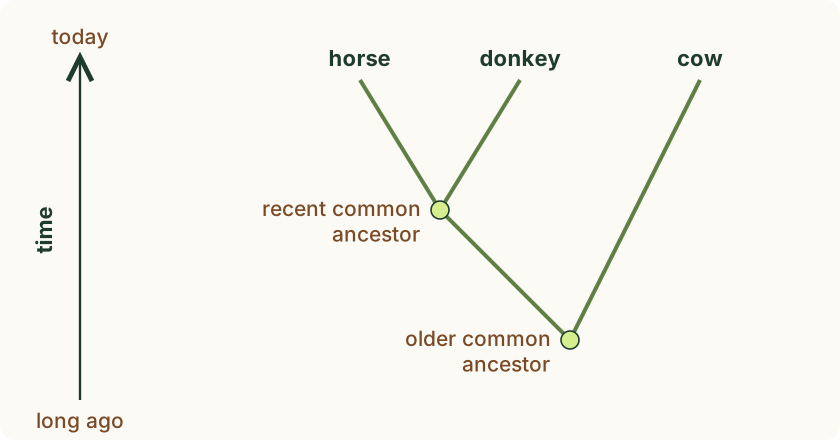
Species change slowly over many generations, and one species can split into two. So the species alive today are related to each other, like members of a huge family. Classification systems aim to reflect evolutionary relationships: species in the same genus are thought to share a more recent common ancestor (a species they both evolved from) than species in different genera. Acer pseudoplatanus and Acer campestre evolved from one ancestral maple; their shared ancestor with the oak lived much longer ago.
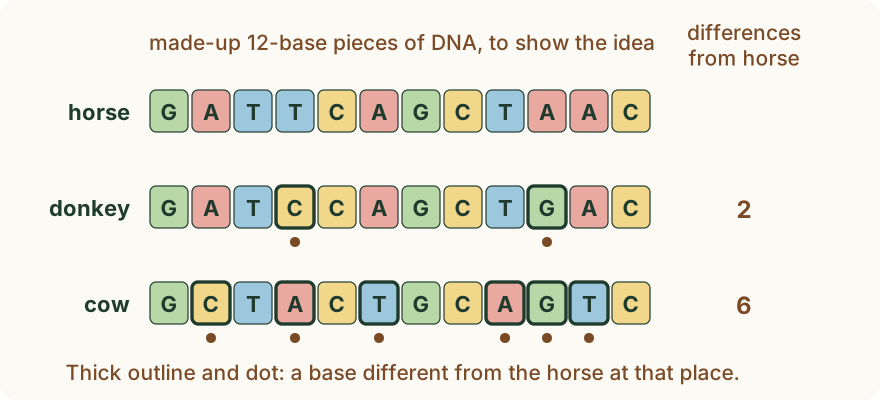
How can anyone know? Features can mislead: a dolphin is shaped like a fish, but it breathes air and feeds its young on milk, like other mammals. Today biologists also compare DNA. The sequence of bases in DNA (A, T, C and G, in a particular order) is copied from parent to offspring, and it changes very slowly over many generations. So the sequences of bases in DNA are used as a means of classification. Two species that split from a common ancestor recently have had little time to change: their base sequences are still very similar. Species whose common ancestor lived long ago have had much more time, so their sequences differ in more places.
 (enlarge)
These 12-base strips are made up to show the idea; real comparisons use thousands of bases. In the strips, the horse and the donkey differ in 2 places, the horse and the cow in 6. Real DNA shows the same pattern: the horse and donkey share a more recent common ancestor, and both are in the genus Equus. The cow is in a different genus and is more distantly related. DNA comparisons like this confirm that the dolphin's closest relatives are mammals, not fish.
 (enlarge)
Trap: "Organisms that look alike are always closely related." Some look alike because they live in a similar way. Groups of organisms that share a more recent ancestor have DNA base sequences that are more similar, so DNA is a better guide than looks alone.
Key idea: Organisms are classified into groups by the features they share. A species is a group of organisms that can reproduce to produce fertile offspring. In the binomial system, the internationally agreed scientific name has two parts, the genus and the species, as in Acer pseudoplatanus. (Supplement) Classification aims to reflect evolutionary relationships; DNA base sequences are used to classify, and organisms that share a more recent ancestor have more similar sequences.