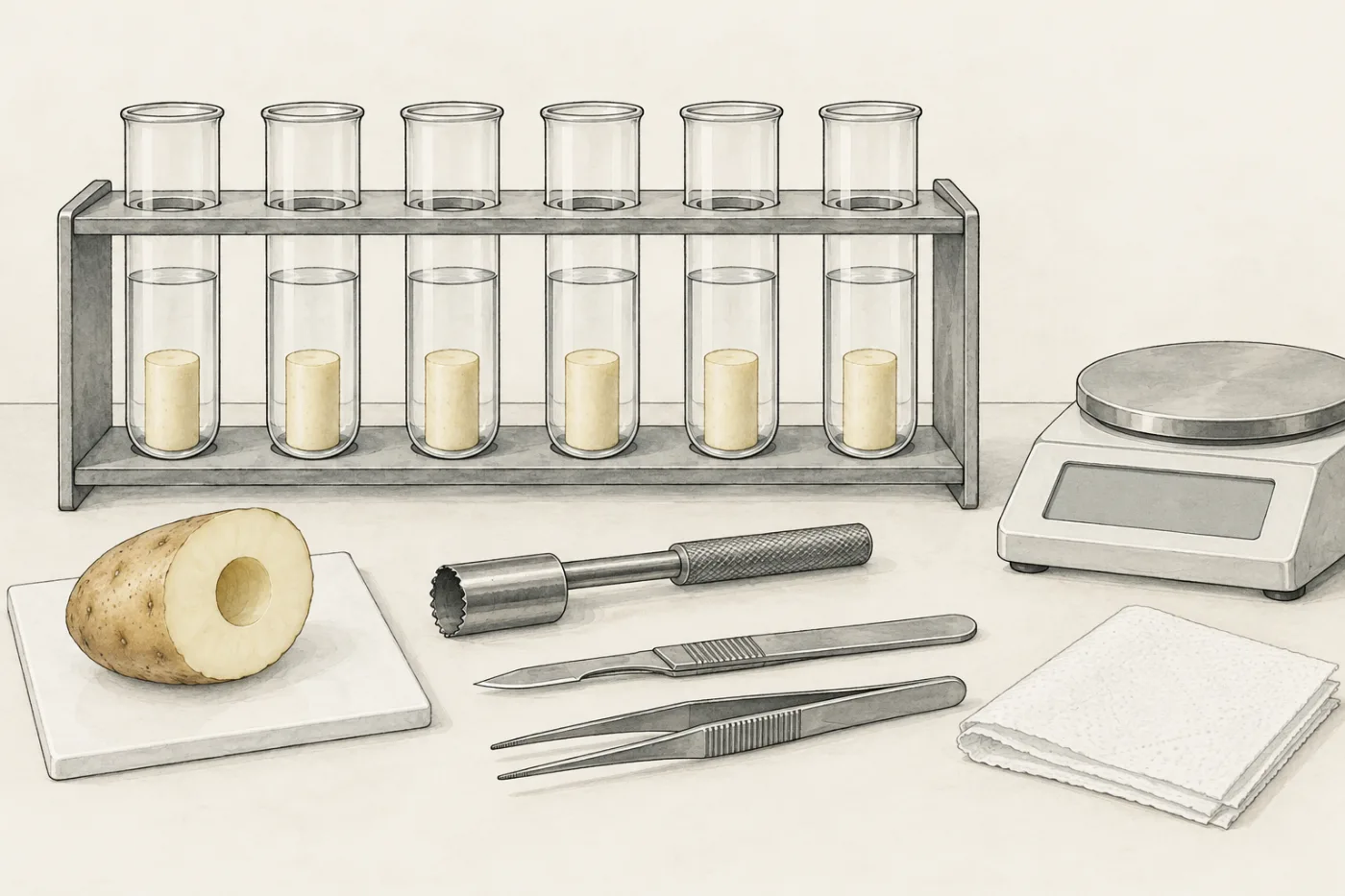
A raw chip of potato left in a glass of water feels hard and snaps. Leave the same chip in very salty or sugary water and it goes soft and bendy. A potato has no bag of dialysis tubing, but each of its cells has a cell membrane. In this part you soak potato cylinders in water and in sugar solutions of different concentrations, weigh them, and bend them.
 (enlarge)
Water in and out of cells
A plant cell has two layers around it. The cell wall on the outside is made of cellulose; it lets water and dissolved substances through freely and is strong. Inside it, the cell membrane is partially permeable. Most of the cell is filled by a large vacuole of cell sap, a solution of sugars and salts.
So every cell is like a tiny bag of solution. Water moves into and out of cells by osmosis through the cell membrane. If the solution outside is more dilute than the cell sap, more water enters than leaves. If it is more concentrated, more water leaves than enters.
Trap: "The cell wall controls what goes in and out." The wall is fully permeable: water and solutes pass straight through it. It is the cell membrane that is partially permeable.
The potato investigation
Six cylinders are cut from the same potato with the same cork borer and trimmed to the same length. Each is blotted gently and weighed, then left for 30 minutes in its own tube: one in water, five in sucrose (sugar) solutions from 0.2 to 1.0 mol/dm³. Then each is lifted out, blotted the same way and weighed again. Predict first: which cylinders will end up heavier, and which lighter?
In this investigation:
- the independent variable, the one you change, is the concentration of the sucrose solution;
- the dependent variable, the one you measure, is the change in mass of the cylinder;
- the controlled variables are kept the same: the same potato, the same diameter and length, the same volume of solution, the same temperature, the same time, and the same gentle blotting (blotting removes liquid on the surface, which would add to the mass).
The cylinders do not all start with exactly the same mass, so you compare percentage changes:
percentage change in mass = (final mass − starting mass) ÷ starting mass × 100
For example, a cylinder that goes in at 1.62 g and comes out at 1.82 g has changed by (1.82 − 1.62) ÷ 1.62 × 100 = +12.3 %. A cylinder that loses mass has a negative change.
What the cylinders showed
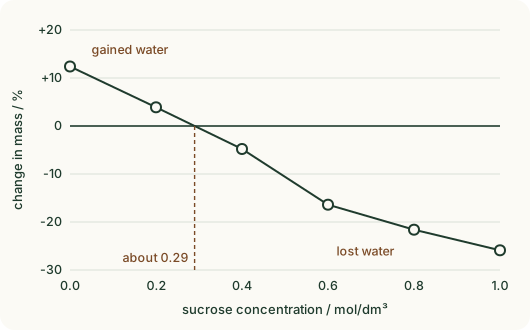
The cylinder from water gained about 12 % in mass, and the one from 0.2 mol/dm³ gained a little. From 0.4 mol/dm³ upwards the cylinders lost mass: the stronger the solution, the more they lost. Three groups' results were averaged. One result did not fit the pattern, so it was checked: that group's notes said the cylinder had not been fully covered by the solution. That is a fault in the method, so the result was left out of the mean (it stays in the table, crossed out), and the tube could be repeated. A result is never left out just because it looks odd; there has to be a reason.
 (enlarge)
Where the cylinders gained mass, water had entered the cells by osmosis: the solution outside was more dilute than the cell sap (it had a higher water potential). Where they lost mass, water had left the cells. The line crosses 0 % at about 0.29 mol/dm³. You can also estimate it from the two means either side of 0: +3.9 % at 0.2 mol/dm³ and −4.8 % at 0.4 mol/dm³. Zero lies 3.9 ÷ (3.9 + 4.8) of the way from 0.2 to 0.4, a little under halfway: about 0.29 mol/dm³. A cylinder in that solution would neither gain nor lose mass: there would be no net movement of water. Water molecules would still cross the membranes both ways, but equally. Real potatoes vary, so this is an estimate, and each class finds its own value.
Trap: "The cylinders in sugar solution lost mass because sugar soaked into them." Very little sucrose crosses the cell membranes in 30 minutes, and sugar soaking in would add mass, not remove it. The mass changed because water moved in or out.
Firm and floppy cells
The cylinders from water and from 0.2 mol/dm³ were firm and snapped when bent. The ones from the strong solutions were soft and bendy. Why?
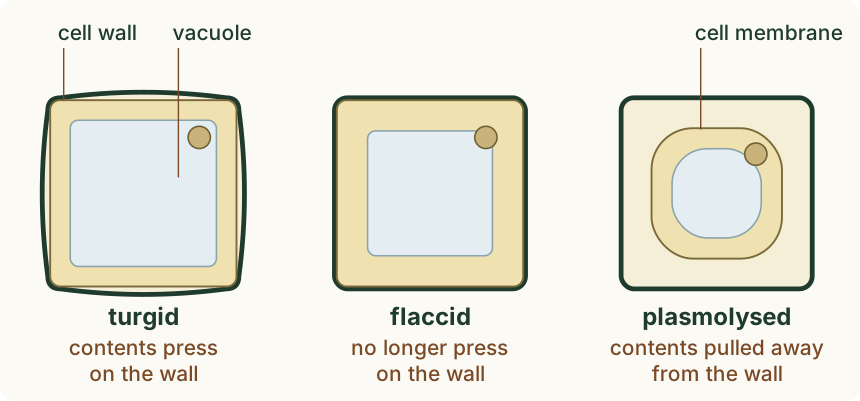
When a plant cell takes in water, its vacuole swells and pushes the cytoplasm and cell membrane against the cell wall. The wall stretches only a little, and pushes back. The cell is now turgid, and the pressure of the cell contents on the wall is called turgor pressure. Turgid cells pressing against each other make the tissue firm, like a pile of pumped-up balloons packed in a box. Plants are supported by the pressure of water inside their cells pressing outwards on the cell wall. Because the wall is strong, a plant cell never bursts. The wall's push also stops the cell filling up without limit: once it pushes back hard enough, as much water leaves the cell as enters, even though the cell sap is still more concentrated than the solution outside. (In water-potential terms, the pressure raises the water potential of the cell.) That is why the potato's no-net-movement point is a little more dilute than its cell sap.
When a cell loses water, its contents shrink a little and stop pressing on the wall. They still touch the wall, but no longer push on it. The cell is flaccid, and the tissue goes soft. If it loses even more water, the cytoplasm and cell membrane pull away from the cell wall: this is plasmolysis. The wall keeps its shape; only the contents shrink.
 (enlarge)
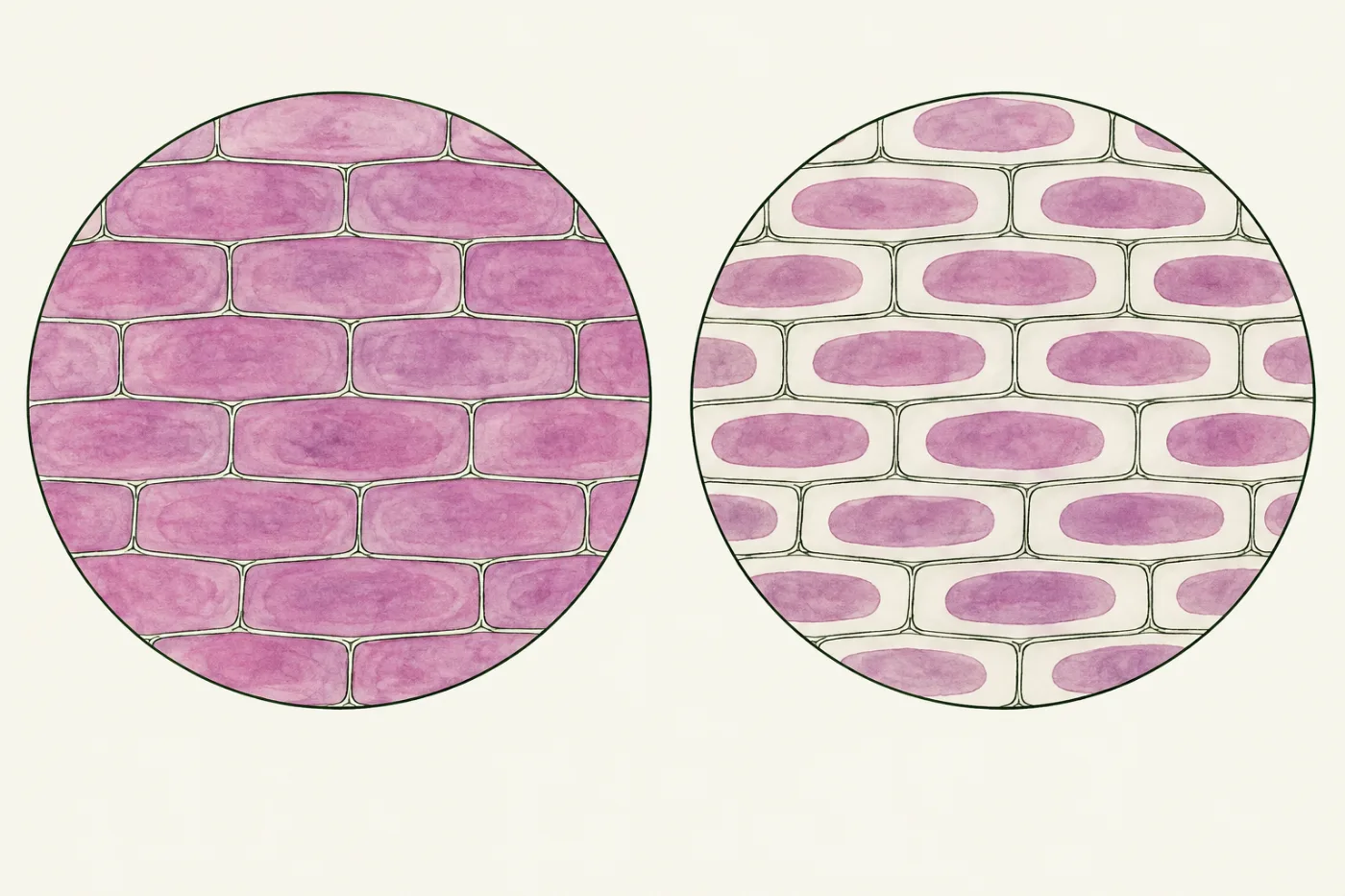
You can see plasmolysis in real cells. Red onion skin has purple cell sap. In water, the purple fills each cell; in strong salt solution, the purple contents shrink away from the walls.
 (enlarge)
Trap: "A flaccid cell is a plasmolysed cell." A flaccid cell has lost enough water to stop pressing on its wall; its contents still touch the wall. Plasmolysis comes only after more water loss, when the contents pull away.
Now the lettuce. A limp leaf has flaccid cells. In water, the water outside has a higher water potential than the cell sap, so water enters the cells by osmosis until they are turgid again, and the leaf is crisp.
Key idea: Plant cells in a dilute solution take in water by osmosis and become turgid; in a concentrated solution they lose water, become flaccid and, after more water loss, plasmolysed. Turgor pressure supports the plant.