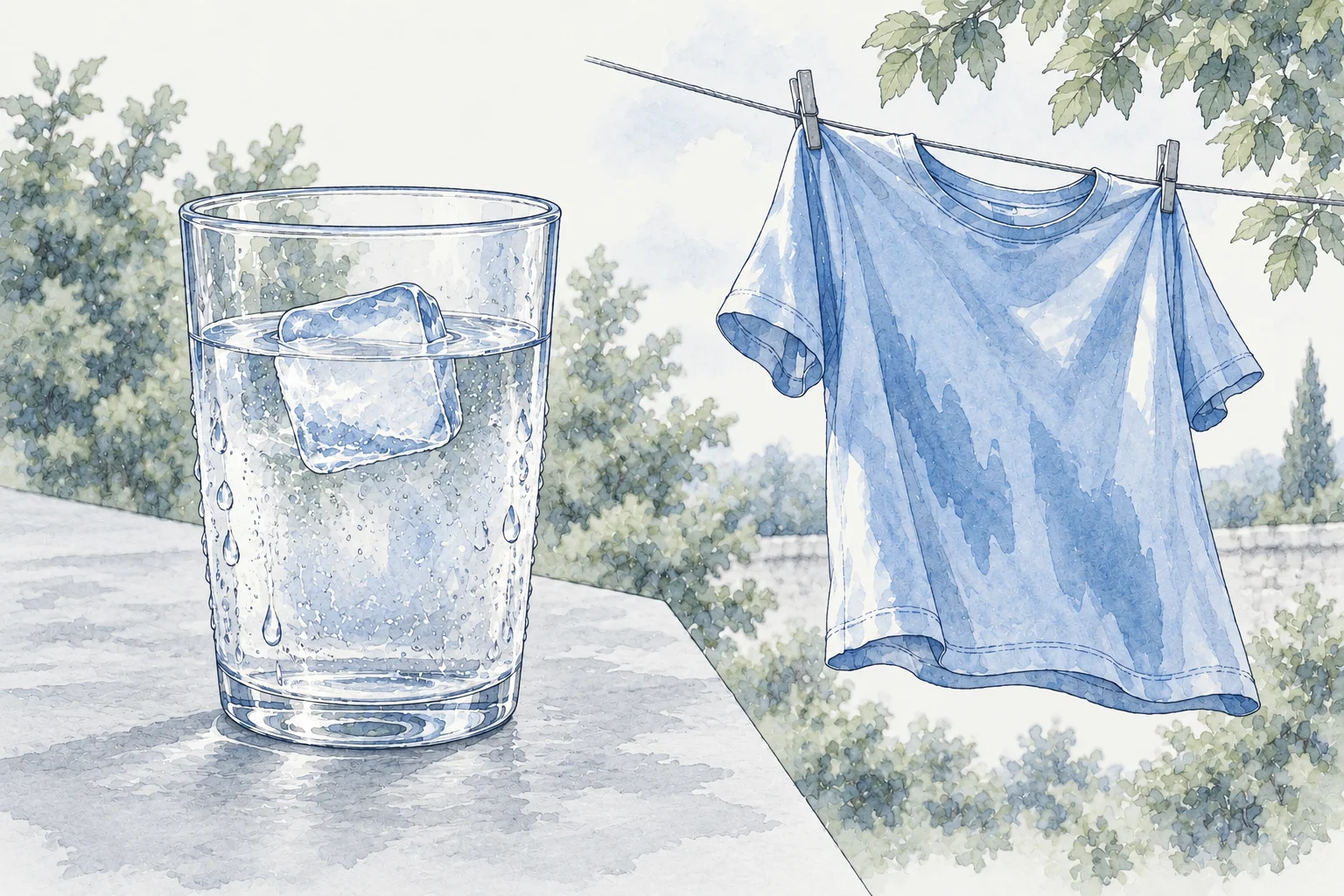
Leave an ice cube in a glass on a warm afternoon. Soon the cube is smaller and the glass holds more water. Hang a wet T-shirt in the sun, and by evening it's dry. The ice turns into liquid water, and the water in the T-shirt seems to vanish. Is it all still water? In this part you'll learn to tell solids, liquids and gases apart by what they do. Then you'll explain the difference with particles.
 (enlarge)
Three ways to behave
Imagine moving three samples from a tall glass into a wide dish: a block of ice, a cup of water and some air in a closed jar. Before you read on, predict which one keeps its shape.
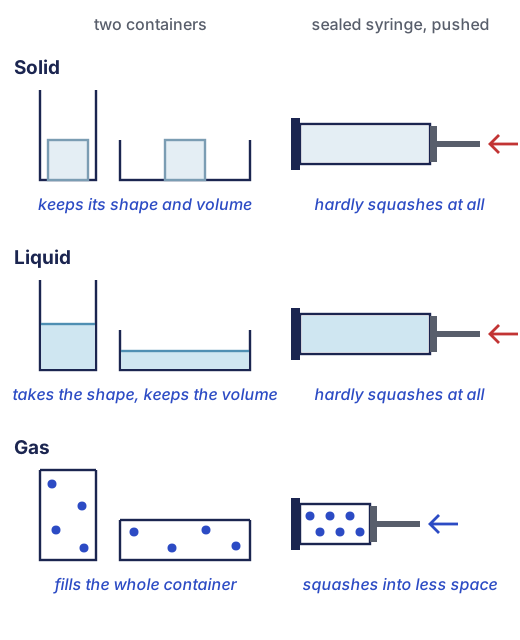
The block of ice keeps its shape and its size. That makes it a solid: it has a fixed shape and a fixed volume. Volume means how much space something takes up.
The water spreads out across the dish. Its shape changes, but the amount of space it takes up doesn't. A liquid has a fixed volume but takes the shape of its container. It flows.
Air behaves differently again. Let the air from a small closed jar into a bigger closed box, and it spreads through the whole box. A gas has no fixed shape and no fixed volume. It spreads out to fill any closed container.
There's one more test. Seal each sample in a syringe and push the plunger. Only the gas squashes into less space: a gas can be compressed. Solids and liquids hardly change their volume at all.
 (enlarge)
Inside: the same molecules
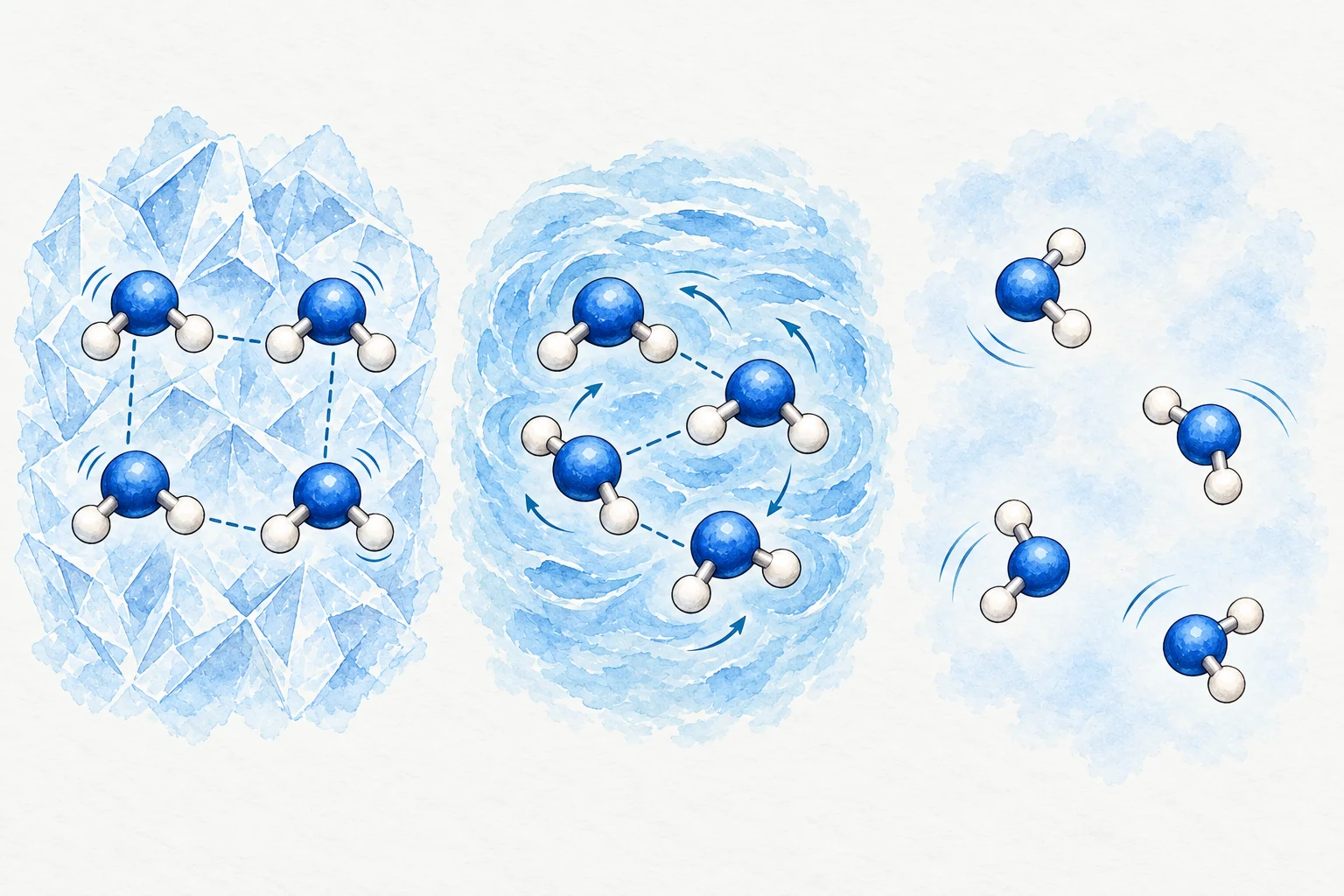
Why do the three states behave so differently? Everything is made of tiny particles, far too small to see. In water, the particles are molecules of H2O: one oxygen atom joined to two hydrogen atoms.
Here's the surprise. Melting doesn't change the molecules. Ice, liquid water and water vapour are all made of the same H2O molecules. What changes is their separation (how close together they are), their arrangement and their motion.
 (enlarge)
| Solid | Liquid | Gas | |
|---|---|---|---|
| Separation | close together, touching | close together, touching | far apart |
| Arrangement | regular pattern | random | random |
| Motion | vibrate about fixed positions | move around each other | move quickly in all directions |
Why don't the particles in a solid or a liquid simply fly apart? Neighbouring particles attract each other. These forces of attraction hold the particles of a solid in fixed positions and keep the particles of a liquid close together. In a gas the particles are so far apart that the attraction hardly matters.
Now the properties make sense.
- A solid keeps its shape because forces of attraction hold its particles in fixed positions. They vibrate, but they can't move past each other.
- A liquid flows because its particles can slide past each other. They stay close together, so the volume stays the same.
- A gas fills its container because its particles move freely until they hit the walls. There's mostly empty space between them, so a gas can be squashed.
Look inside ice and water
Drag the round handle across the beaker and compare the molecules in the ice with those in the liquid around it.
When you've compared them, open the ••• menu and choose “Ring one molecule”. Watch a ringed molecule in the ice: does it ever leave its place?
Trap: “Particles in a solid don't move.” They vibrate all the time; they just stay in their places. Heating makes them vibrate faster.
Trap: “Gas particles are bigger than liquid particles.” The molecules are the same size. In a gas, the spaces between them are much larger.
Ice is a little unusual
Look at the glass at the top of this page: the ice floats. In most substances, the solid packs its particles a little more tightly than the liquid does, so the solid sinks in its own liquid. Water is one of the few exceptions. The regular pattern in ice holds its molecules slightly further apart than in liquid water, so ice is less dense and floats. You'll see the last of the ice float in the beaker when you heat it in part 2.
Both ice and liquid water still count as “close together”; only in water vapour (steam) are the molecules far apart.
Worked example
Is sand a liquid?
A pupil pours dry sand from a jug into a bowl. It flows and ends up the shape of the bowl. Is sand a liquid?
Look at one grain. It has a fixed shape and a fixed volume, so each grain is a solid. The pile flows only because many separate grains slide past each other. Notice another difference: a liquid settles with a level surface, but a pile of sand keeps a slope. Sand is a solid in small pieces.
Worked example
Why does air squash but water doesn't?
Fill one sealed syringe with air and another with water. Push both plungers. The plunger of the air syringe moves in; the water syringe's plunger barely moves.
The observation tells you that the gas has a volume that can change, and the liquid doesn't. The reason is separation. Gas particles are far apart, with mostly empty space between them, so pushing moves them closer together. Liquid particles are already close together, touching each other, so there's almost no space to remove.
Case closed
To decide the state of a sample, ask four questions. Does it keep its shape? Does it keep its volume? Does it flow? Can it be squashed?
To explain the state, describe the particles: their separation, their arrangement and their motion.
About this model
The pictures draw molecules as balls, enlarged and far fewer than in real water. In the experiment, all molecules are drawn the same size; their paths illustrate arrangement and motion and are not a calculation of real molecular motion.