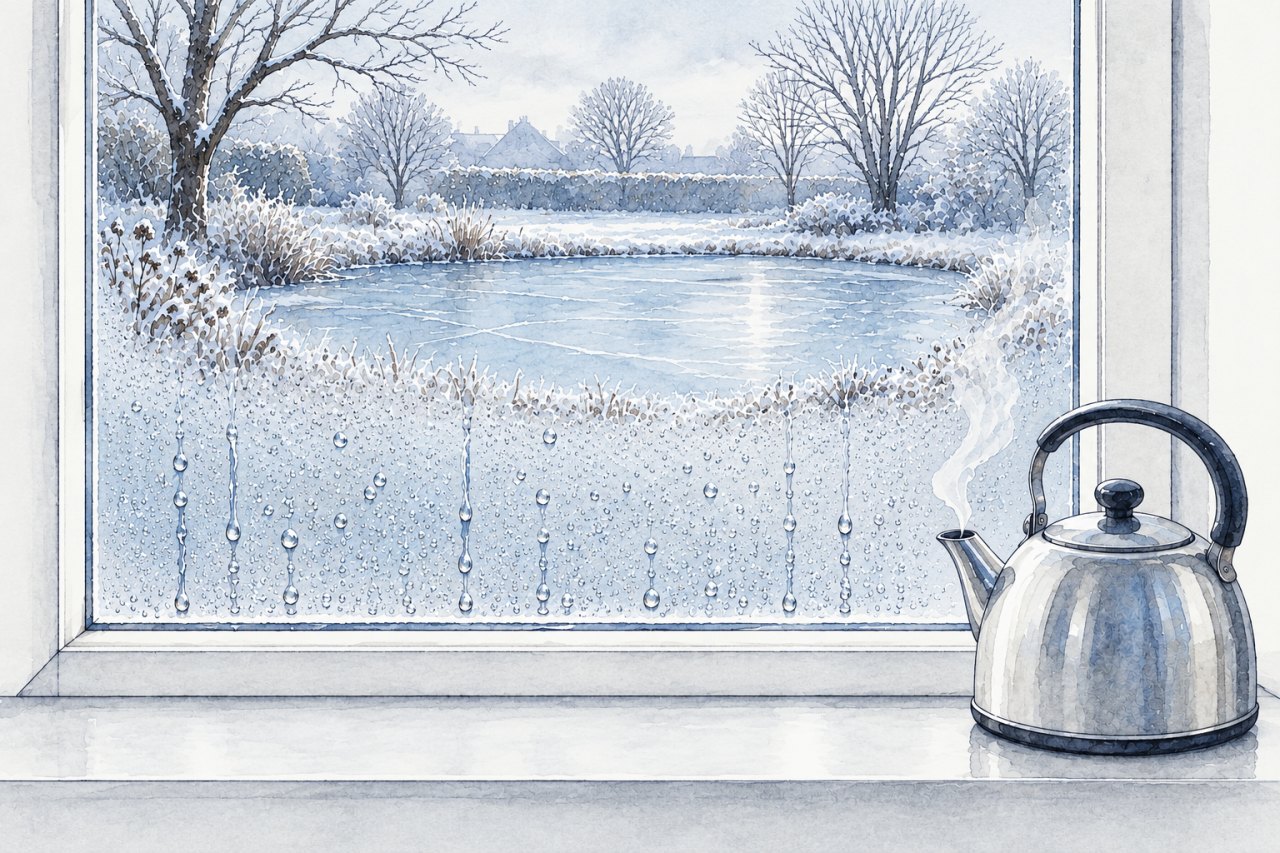
On a cold morning, the inside of the kitchen window is covered with drops of water. Outside, the pond has turned to ice. Nobody poured water on the window. Where did it come from? In this part you'll follow the changes in reverse: gas to liquid, then liquid to solid. You'll read cooling curves and use melting and boiling points to predict the state of any substance.
 (enlarge)
Condensing: gas to liquid
The air in a kitchen always contains some water vapour, a gas. The kettle adds more. When water molecules in the air hit the cold glass, they lose energy and slow down. Forces of attraction pull them close together, and they form drops of liquid. A gas changing into a liquid is condensing, also called condensation. Like evaporation, this happens far below 100 °C.
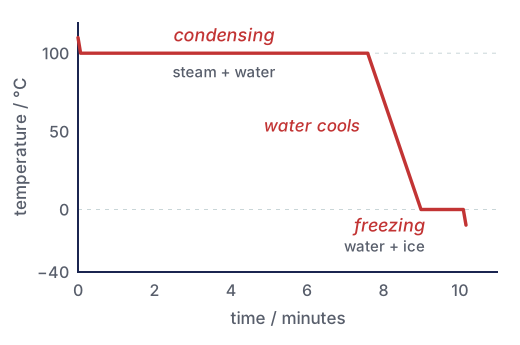
Pure water vapour behaves differently. Cool steam (water vapour with no air mixed in) at normal atmospheric pressure, and it condenses at 100 °C, its boiling point. The temperature then stays at 100 °C until all of it has condensed: boiling in reverse. Water vapour mixed with air condenses on any surface that is cold enough: evaporation in reverse.
 (enlarge)
Trap: “The water on the outside of a cold glass leaked through it.” Glass doesn't let water through. Water vapour from the air condensed on the cold surface. That's where the drops on the glass in part 1 came from.
Trap: “The white cloud above a kettle is a gas.” Water vapour is invisible. The white cloud is tiny drops of liquid water that have already condensed in the cooler air.
Freezing: liquid to solid
Now cool liquid water. Its molecules move more and more slowly. At 0 °C they settle into fixed positions in a regular pattern, and the water becomes ice. A liquid changing into a solid is freezing.
For a pure substance, the freezing point is the same temperature as its melting point. Water freezes, and ice melts, at 0 °C. Which one happens depends on whether the water is losing or gaining energy.
The cooling curve
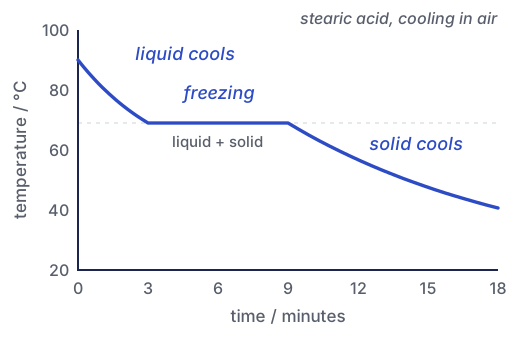
Melt some stearic acid, a waxy solid, in a test tube. Then let it cool in air and record its temperature every minute. Predict the shape of the graph before you look.
 (enlarge)
Did you predict a flat part? The temperature falls, stays at 69 °C for several minutes, then falls again. The flat part is freezing. The tube is still losing energy to the cooler room. But as the particles move into fixed positions, forces of attraction pull them together, and energy is released. That energy replaces what the tube loses, so the temperature stays constant until all the liquid has frozen.
Key idea: Flat parts on heating and cooling curves are changes of state. On heating, energy is taken in to overcome forces between particles. On cooling, energy is released as forces pull the particles together.
Which state at a given temperature?
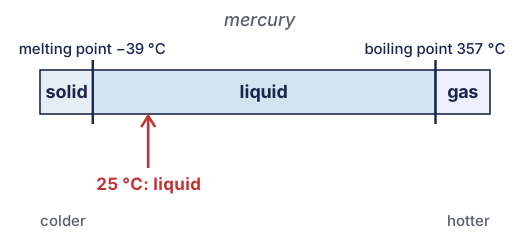
Melting and boiling points tell you the state of a substance at any temperature.
- Below its melting point, it's a solid.
- Between its melting point and its boiling point, it's a liquid.
- Above its boiling point, it's a gas.
 (enlarge)
Trap: “Its boiling point is above room temperature, so it must be a liquid.” Check the melting point too. Iron boils far above room temperature, but it also melts far above room temperature, so it's a solid.
The five changes of state
 (enlarge)
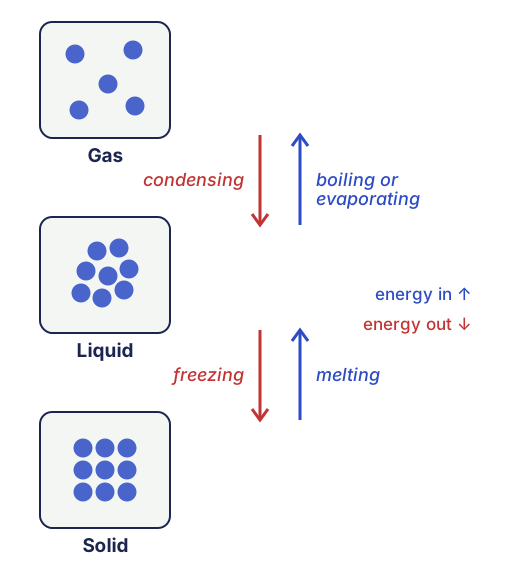
Melting and freezing link solids and liquids. Boiling, evaporating and condensing link liquids and gases. In every one, the particles themselves stay the same; their separation, arrangement and motion change.
Worked example
Reading a cooling curve
Use the stearic acid curve. What is its freezing point, what is in the tube at 6 minutes, and why is the temperature constant there?
The flat part is at 69 °C, so the freezing point is 69 °C. At 6 minutes the temperature is on the flat part: freezing is under way, so liquid and solid stearic acid are both present. The temperature stays constant because energy released as particles are pulled into fixed positions replaces the energy lost to the room. Its melting point is also 69 °C: the same temperature, reached by heating instead of cooling.
Worked example
Solid, liquid or gas at 25 °C?
Mercury melts at −39 °C and boils at 357 °C. Is it a solid, a liquid or a gas at 25 °C?
Compare 25 °C with each point, as on the temperature line above. It's above the melting point, so mercury isn't a solid. It's below the boiling point, so mercury isn't a gas. Between the two, mercury is a liquid: the silvery liquid metal once used in thermometers.
Case closed
Condensing is the reverse of boiling and evaporating; freezing is the reverse of melting. On a cooling curve, a flat part shows a change of state: energy released as particles are pulled together keeps the temperature steady. To find the state at any temperature, compare it with the melting point and the boiling point.
About this model
Real cooling curves bend, because a warm sample loses heat more slowly as it nears room temperature. Some liquids cool a little below their freezing point before crystals start to form; our figures leave this out. The steam curve assumes energy is removed at a steady rate, like the hotplate run backwards.