Pupil sheet · States and changes of state
Where does the heat go? — questions
Name ______________________ Date ____________
Try every question before you use a nudge. Write in full sentences where you are asked to explain.
1. identify / explain
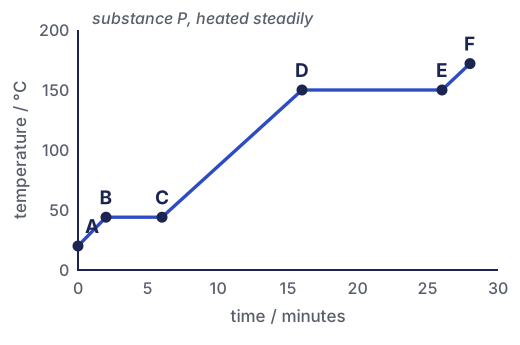
The graph shows substance P heated at a steady rate. What is the melting point of P? Explain which part of the graph tells you.
Circle one answer.
- 20 °C
- 44 °C
- 150 °C
- 172 °C
Which part of the graph tells you, and why?
Nudge (only if you are stuck): Melting is the first change of state on heating. Which part of the graph shows it?
2. identify / explain
Which statements are true for evaporation but not for boiling? Then explain why a puddle can dry without boiling.
Tick every correct statement.
- It happens only at the surface of the liquid.
- It can happen below the boiling point.
- Bubbles of gas form throughout the liquid.
- For a pure liquid, it happens at one fixed temperature.
Why can a puddle dry without boiling?
Nudge (only if you are stuck): Think of a puddle drying on a cool day. Where do the particles leave from?
3. state / explain
On the heating curve of substance P, the temperature stays at 150 °C from D to E, although heating continues. Name the change of state. Explain, using particles, why the temperature doesn't rise.
Change of state from D to E
Why the temperature stays at 150 °C
Nudge (only if you are stuck): Is P changing state between D and E? What does a change of state need energy for?
4. describe
Ice at −10 °C is heated steadily until all the water has boiled away. Put the stages in order. Then say which two stages show no rise in temperature, and why.
Write the number of each step in order.
- Liquid water warms up
- Ice warms up
- Water boils
- Ice melts
- First: ______
- Second: ______
- Third: ______
- Fourth: ______
Which two stages show no rise in temperature, and why?
Nudge (only if you are stuck): Which stages are changes of state?
5. identify / explain
A beaker of water is kept at 70 °C on a hotplate. After an hour its level has fallen, but no bubbles ever formed inside the water. Is the water boiling or evaporating? Explain, and say what you would see if it started to boil.
Boiling or evaporating, and why
What you would see if it started to boil
Nudge (only if you are stuck): Where are the molecules leaving from, and is the water at its boiling point?
6. describe / explain
Ethanol melts at −114 °C and boils at 78 °C. Work on paper only: ethanol catches fire easily. (a) Describe the heating curve you would expect if solid ethanol at −130 °C were heated steadily to 100 °C. (b) A beaker of ethanol stands in a warm water bath at 60 °C. Its level falls, but no bubbles form inside it. Name the process, explain it, and say what would change if the ethanol reached 78 °C.
(a) Shape of the heating curve and what is present at each flat part
(b) The process in the warm bath, and what would change at 78 °C
Nudge (only if you are stuck): Where will the curve be flat, and what will be present there? For (b): compare 60 °C with the boiling point.