Pupil sheet · States and changes of state
Cooling it back down — questions
Name ______________________ Date ____________
Try every question before you use a nudge. Write in full sentences where you are asked to explain.
1. deduce / state
Liquid T at 95 °C is left to cool in air. The graph shows its temperature. Fill in each gap.
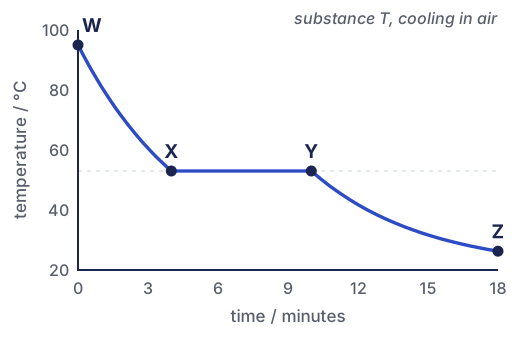
Temperature of the flat part X–Y / °C
State of T from W to X
What is happening from X to Y
Why the temperature stays constant from X to Y
State of T at Z
Nudge (only if you are stuck): The flat part is a change of state. Which change happens when a liquid cools, and what do the particles do during it?
2. deduce
Use the melting points and boiling points in the table. Match each substance to its state at 25 °C.
| Substance | Melting point / °C | Boiling point / °C |
|---|---|---|
| Oxygen | −218 | −183 |
| Bromine | −7 | 59 |
| Iron | 1538 | 2862 |
Write the number of the matching option.
- Solid
- Liquid
- Gas
- Oxygen: ______
- Bromine: ______
- Iron: ______
Nudge (only if you are stuck): Is 25 °C below the melting point, between the two points, or above the boiling point?
3. identify / explain
Which of these are examples of condensing? Then explain what all your choices have in common.
Tick every correct statement.
- Drops forming on a bathroom mirror after a shower
- A puddle drying in the sun
- Glasses misting up when you walk into a warm room from the cold
- Ice forming on a pond overnight
- Dew forming on grass on a cold night
What do all your choices have in common?
Nudge (only if you are stuck): Condensing starts with a gas. Which examples start with water vapour?
4. state / explain
Steam from boiling water is passed through a glass tube with cold water flowing around the outside. Liquid water drips from the end of the tube. (a) Name the change of state in the tube. (b) Explain, using particles, why the steam turns into a liquid there. (c) Pure steam at normal pressure: at what temperature does it change state?
(a) Change of state
(b) Particle explanation
(c) Temperature of the change for pure steam
Nudge (only if you are stuck): Follow one steam particle as it meets the cold glass. What changes for it, and what happens next?
5. deduce / explain
Gallium is a metal. It melts at 30 °C and boils at 2400 °C. A piece of gallium is held in a hand at 37 °C until it reaches the same temperature. What state is it in? Explain your choice.
Circle one answer.
- Solid
- Liquid
- Gas
Explain your choice using both points.
Nudge (only if you are stuck): Compare 37 °C with both points, not just one.
6. deduce / state / explain
A pupil melts some pure substance V, then records its temperature as it cools. (a) Deduce the freezing point of V and say how the data show it. (b) State what is present at 1, 5 and 10 minutes. (c) Is V solid or liquid on a hot day at 35 °C? Explain. (d) Pure ammonia boils at −33 °C. Ammonia gas is cooled from 20 °C. At what temperature does it start to condense, and what happens to the temperature while it condenses?
| Time / minutes | 0 | 1 | 2 | 3 | 4 | 5 | 6 | 7 | 8 | 9 | 10 |
|---|---|---|---|---|---|---|---|---|---|---|---|
| Temperature / °C | 80 | 72 | 65 | 59 | 58 | 58 | 58 | 58 | 54 | 47 | 41 |
(a) Freezing point and evidence
(b) What is present at 1, 5 and 10 minutes
(c) State at 35 °C and why
(d) Where ammonia condenses and what the temperature does
Nudge (only if you are stuck): Look for readings that stay the same. For (d): on cooling, which point does a pure gas condense at?