Pupil sheet · Melting, boiling and evaporation
Melting, boiling and evaporation — final check
Name ______________________ Date ____________
Work alone, with the lesson closed. Answer every question; there are no hints.
1. state / determine / describe / explain
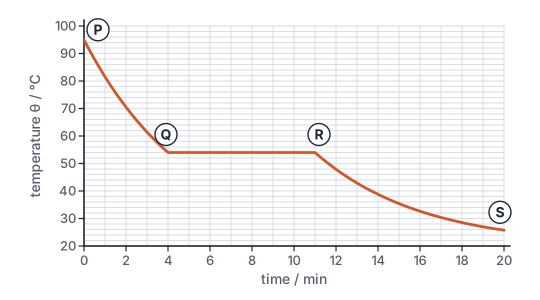
Liquid substance Z cools in a tube in a room. The graph shows its temperature. (a) State the freezing point of Z. (b) Determine how many minutes Z took to freeze. (c) Describe what happens to the particles of Z between Q and R. (d) Explain why the temperature stays the same between Q and R. (e) Solid Z is heated steadily from 20 °C until it is all liquid. Describe the shape of its heating curve, and explain what the energy does while Z melts. (f) A pupil says that Z is water. Use the graph to explain why Z is not pure water at standard atmospheric pressure. (g) Another pupil keeps a beaker of pure water boiling with a Bunsen burner, at standard atmospheric pressure, and reads its thermometer every minute. All ten readings are the same. State the reading, and explain why it does not rise although the burner supplies energy all the time. (h) In another experiment, steam passes along a glass tube with cold water flowing round the outside, and liquid water drips out of the far end. Describe, in terms of particles, what happens to the steam in the tube, and say where the energy goes.
(a) Freezing point
(b) Time taken to freeze
(c) Particles from Q to R
(d) Why the temperature is steady
(e) Heating Z
(f) Why Z is not water
(g) Boiling water
(h) Steam in a cold tube
2. describe / explain
A pupil pours 20.0 g of water at 20 °C into each of four dishes and leaves them for 3 hours in a room at 20 °C. The table shows where each dish stood and the mass of water it lost. (a) Describe, in terms of particles, how the water in a dish goes into the air. (b) During the experiment, the water in dish Q fell to 17 °C, below the 20 °C room. Explain why. (c) Use the table to explain how air movement, surface area and temperature each affect evaporation. For each, name the two dishes you compare. (d) Describe two ways in which what happens to the water in the dishes differs from water boiling in a kettle. (e) A hiker on a hot day soaks her hat in a stream and puts it on. Explain why her head feels cooler.
| dish | width | where it stood | water lost in 3 hours / g |
|---|---|---|---|
| P | wide | in a draught from an open window | 6.2 |
| Q | wide | still air, on a shelf | 3.1 |
| R | narrow | still air, on a shelf | 1.0 |
| S | wide | still air, on a sunny windowsill; the sun warmed its water to 30 °C | 5.0 |
(a) How the water goes into the air
(b) Why Q was at 17 °C
(c) The three factors
(d) Compared with a boiling kettle
(e) The wet hat