Pupil sheet · Melting, boiling and evaporation
Melting and boiling — questions
Name ______________________ Date ____________
Try every question before you use a nudge. Write in full sentences where you are asked to explain.
1. identify / explain
A beaker holds a mixture of ice and water at 0 °C. It is heated gently and stirred. While there is still some ice in the beaker, the thermometer stays at 0 °C. Which statement explains this? Then explain your choice.
Circle one answer.
- No energy goes into the beaker until all the ice has melted
- The energy separates the particles, breaking them out of their fixed positions, so they do not move faster on average
- The ice is so cold that it cancels out the energy from the heater
- The thermometer cannot read above 0 °C while ice is touching it
Why?
Nudge (only if you are stuck): The heater is on the whole time. Ask what job its energy is doing while there is still ice to melt.
2. complete
Complete the sentences. Pure water at standard atmospheric pressure melts at ____ (1) °C and boils at ____ (2) °C. While water boils, energy is supplied all the time, but the temperature stays the ____ (3). The energy pulls the particles far ____ (4), against the forces between them, so the water becomes a gas. Turning the hob up makes the water boil away ____ (5), but it does not make it hotter.
Gap 1
Gap 2
Gap 3
Gap 4
Gap 5
Nudge (only if you are stuck): Two gaps are temperatures on the Celsius scale. For the others, think about what the energy does to the particles while water boils.
3. identify
Pure water at standard atmospheric pressure. Match each change to the temperature at which it happens.
Write the number of the matching option.
- 0 °C
- 100 °C
- −10 °C
- 37 °C
- 50 °C
- Ice melts: ______
- Water boils: ______
- Steam, cooled from 120 °C, condenses: ______
- Water freezes: ______
Nudge (only if you are stuck): Melting and freezing happen at the same temperature; so do boiling and condensing.
4. describe
Steam at 110 °C is cooled until it is ice at −10 °C. Put the stages in order, from first to last.
Write the number of each step in order.
- At 0 °C the water freezes: the particles settle into fixed positions and can only vibrate
- The steam cools to 100 °C: its particles slow down
- The ice cools below 0 °C: its particles vibrate more slowly
- At 100 °C the steam condenses: the particles come close together, held by the forces between them
- The water cools from 100 °C to 0 °C: its particles move past each other more slowly
- Step 1: ______
- Step 2: ______
- Step 3: ______
- Step 4: ______
- Step 5: ______
Nudge (only if you are stuck): Two of the stages are changes of state, each at one fixed temperature. In the other three the temperature falls.
5. identify / explain
Water vapour in the air of a warm kitchen condenses on a cold window. Which statement describes what happens to the particles? Then explain your choice.
Circle one answer.
- The particles come close together, and the forces between them hold them close
- The particles get smaller, so they fit together as a liquid
- The particles settle into fixed positions in a regular pattern
- The particles speed up and spread out
Why?
Nudge (only if you are stuck): Condensing turns a gas into a liquid. In a liquid, how close together are the particles, and are they in fixed positions?
6. explain
A cook turns the gas under a pan of boiling water from low to high. The water bubbles harder, but a thermometer in it still reads 100 °C. Explain, in terms of energy and particles, why the temperature does not rise, and what the extra energy does.
Nudge (only if you are stuck): Where does the energy go while water boils? What does more energy each second change?
7. determine / explain
A solid, substance Y, is heated steadily from 20 °C. The graph shows its temperature. Use the graph to find (a) the melting point and (b) the boiling point of Y. Then explain what is happening to the energy between 3 and 8 minutes.
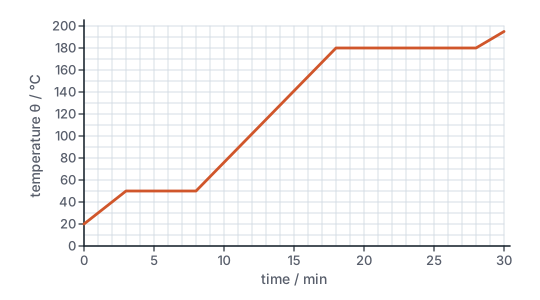
(a) Melting point of Y: ______________ unit ________
(b) Boiling point of Y: ______________ unit ________
What happens to the energy from 3 to 8 minutes?
Nudge (only if you are stuck): A level part of a heating curve is a change of state. As a solid is heated, the first is melting and the second is boiling.
8. determine / state / explain / suggest
A pupil melts some stearic acid in a boiling tube in hot water, takes the tube out, and reads the temperature every 30 s as it cools. The table and the graph show the readings. (a) Determine the freezing point of stearic acid. (b) State the time interval during which it was freezing. (c) Explain, in terms of particles and energy, why the temperature stayed the same during that time. (d) Suggest one way to make the result more reliable.
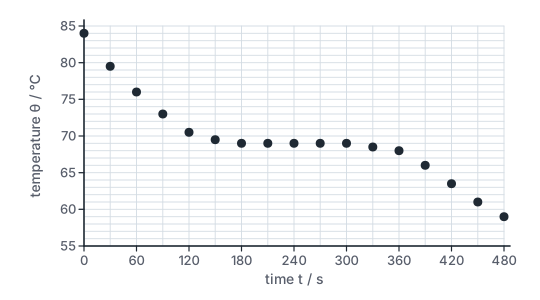
| t / s | θ / °C |
|---|---|
| 0 | 84.0 |
| 30 | 79.5 |
| 60 | 76.0 |
| 90 | 73.0 |
| 120 | 70.5 |
| 150 | 69.5 |
| 180 | 69.0 |
| 210 | 69.0 |
| 240 | 69.0 |
| 270 | 69.0 |
| 300 | 69.0 |
| 330 | 68.5 |
| 360 | 68.0 |
| 390 | 66.0 |
| 420 | 63.5 |
| 450 | 61.0 |
| 480 | 59.0 |
(a) Freezing point
(b) When it was freezing
(c) Particles and energy
(d) One improvement
Nudge (only if you are stuck): Look for the readings that stay the same. A level part of a cooling curve is a change of state.
9. identify / explain
Which of these statements about pure water at standard atmospheric pressure are correct? Choose all that are correct, then explain one of your choices.
Tick every correct statement.
- Ice melts at 0 °C
- While ice melts, energy goes in but the temperature stays at 0 °C
- Boiling water gets hotter if you heat it harder
- Water boils at 100 °C
- While water boils, no energy is being supplied
- Salt water freezes at exactly 0 °C
Explain one of your choices.
Nudge (only if you are stuck): Two statements give the fixed temperatures of pure water. Check each statement about energy against the flat parts of the heating curve.
10. describe / state
A can of drink is taken out of a fridge on a warm day, and its outside is soon covered in tiny drops of water. Later, some water in an ice-cube tray freezes in a freezer. For each change, state its name and describe what happens to the particles. Say whether energy is taken in or given out.
Nudge (only if you are stuck): Name the state before and after each change. Then describe how close together the particles are, and whether they are in fixed positions.
11. state / explain / describe / suggest / predict
A cook lifts the lid off a pan of water that has been boiling hard for 10 minutes. Drops of water run down the inside of the lid. (a) State the temperature of the water, and explain why it has not risen. (b) Describe, in terms of particles, how the drops form on the inside of the lid. (c) Steam at 100 °C scalds skin worse than the same mass of water at 100 °C. Suggest why. (d) In a cabin high in the mountains, water boils at 90 °C. Predict whether pasta cooks faster or more slowly there, and explain. (e) A glass of water with ice cubes in it stands in a warm kitchen, and a pupil stirs it gently. Predict the reading of a thermometer in the water while there is still some ice in the glass. Explain, in terms of energy and particles, what happens to the ice. (f) A tray of water at 20 °C goes into a freezer at −18 °C, with a temperature probe in the water. The reading falls to 0 °C, stays at 0 °C for about an hour, then falls again. Describe what the water particles do while the reading falls to 0 °C, and while it stays at 0 °C. Say where the energy goes.
(a) Temperature and why
(b) Drops on the lid
(c) Why steam scalds worse
(d) In the mountains
(e) Ice in a glass of water
(f) Water in the freezer
Nudge (only if you are stuck): (a) and (d) are about the boiling point; (b) and (c) are about condensing, the reverse of boiling; (e) and (f) are about melting and freezing, at the melting point.