Pupil sheet · Melting, boiling and evaporation
Evaporation and cooling — questions
Name ______________________ Date ____________
Try every question before you use a nudge. Write in full sentences where you are asked to explain.
1. identify / explain
A puddle dries up on a cool day, far below 100 °C. Which statement describes evaporation in terms of particles? Then explain your choice.
Circle one answer.
- All the particles slowly heat up to 100 °C, then turn into a gas
- The more energetic particles near the surface escape into the air
- Any particle, anywhere in the liquid, escapes if it is fast enough
- The particles break up into smaller pieces that float away
Why?
Nudge (only if you are stuck): Where must a particle be to escape from the liquid, and how fast must it be moving?
2. complete
Complete the sentences. In a liquid, the particles move at a ____ (1) of speeds. The more energetic particles near the ____ (2) can escape into the air: this is evaporation. The particles that stay in the liquid have a lower ____ (3) kinetic energy, so the liquid that stays is ____ (4). Evaporation causes cooling of a liquid.
Gap 1
Gap 2
Gap 3
Gap 4
Nudge (only if you are stuck): Which particles escape, the fastest or the slowest? What does that do to the average of the particles that stay?
3. calculate / explain
In the still-air run, balance B read 81.23 g at the start and 80.59 g after 5 minutes. The cork closed tube B. Calculate the mass of water that evaporated from towel B. Then explain how you know the water came from the towel.
Mass of water evaporated: ______________ unit ________
How do you know the water came from the towel?
Nudge (only if you are stuck): Mass lost = the reading at the start − the reading at the end.
4. explain
Put the steps in order to explain why the water in tube B, in the wet towel, cooled faster than the water in tube A.
Write the number of each step in order.
- Energy passes from the warmer tube into the cooler wet towel
- The more energetic water particles escape from the surface of the wet towel
- So the water in tube B loses energy faster, and its temperature falls faster
- The water that stays in the towel has a lower average kinetic energy: it is cooler
- Step 1: ______
- Step 2: ______
- Step 3: ______
- Step 4: ______
Nudge (only if you are stuck): Start with the particles at the surface of the towel, and end with the thermometer in tube B.
5. identify
Match each observation from the still-air run to the best explanation.
Write the number of the matching option.
- Water evaporated from the wet towel; the corks kept the water in both tubes
- The room-temperature water on towel B took energy as it warmed up, and the wet towel let energy pass more easily
- Evaporation kept the towel’s water cooler, so energy kept passing from the warmer tube into it
- As the towel cooled, fewer of its water particles had enough energy to escape
- Tube A’s thermometer was faulty
- The water inside tube B was boiling
- Balance B fell by 0.64 g, but balance A did not change: ______
- In the first 30 s, tube B fell by 7.0 °C and tube A by only 2.0 °C: ______
- From 30 s to 300 s, tube B still fell by 18.5 °C and tube A by 9.0 °C: ______
- Balance B fell by 0.15 g in the first minute, but only 0.10 g in the last minute: ______
Nudge (only if you are stuck): Two observations are about the balance and two about the thermometers. For the first 30 s, remember that the water on towel B started at room temperature.
6. determine / explain
A thermometer reads 20.0 °C in a room at 20 °C. A pupil dips its bulb in ethanol, also at 20 °C, lifts it out, and reads it every 30 s. The graph shows the readings. Use the graph to find (a) the lowest reading and (b) how far the reading fell below the room temperature. Then explain why the reading fell, and why it rose again.
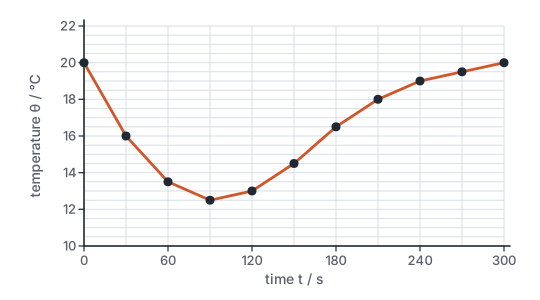
(a) Lowest reading: ______________ unit ________
(b) Fall below room temperature: ______________ unit ________
Why did the reading fall, and why did it rise again?
Nudge (only if you are stuck): The ethanol on the bulb evaporates. What does that do to the ethanol that stays on the bulb, and what happens once it has all gone?
7. explain
A cyclist stops at the top of a hill on a hot, dry day. Her skin is wet with sweat, and she soon feels cooler. Explain, in terms of particles and energy, how the sweat cools her skin.
Nudge (only if you are stuck): Follow the chain from the towel experiment: which particles escape from the sweat, what happens to the sweat that stays, and which way does energy pass?
8. identify / explain
In the still-air run, which reading is the best evidence that water evaporated from towel B? Then explain your choice.
Circle one answer.
- Tube B fell by 25.5 °C, more than tube A
- Balance B fell by 0.64 g, while balance A did not change
- Tube B fell by 7.0 °C in the first 30 s
- Towel B was still damp at the end
Why is it the best evidence?
Nudge (only if you are stuck): Which reading measures water going into the air? Which readings could also have other causes?
9. explain / suggest / predict
A nurse wipes a patient’s arm with a swab soaked in alcohol before an injection. The alcohol is at room temperature, but the arm feels cold, and the skin is dry within a few seconds. (a) Explain, in terms of particles, why the alcohol disappears from the skin. (b) Explain why the arm feels cold, although the alcohol was at room temperature. (c) Water at room temperature, wiped on the other arm, feels less cold and takes much longer to dry. Suggest why. (d) Predict what a thermometer with its bulb wrapped in a swab of alcohol would read, compared with the room, while the swab is wet, and after it has dried.
(a) Why the alcohol disappears
(b) Why the arm feels cold
(c) Water instead
(d) The thermometer
Nudge (only if you are stuck): This is the wet towel again, with alcohol instead of water and an arm, or a thermometer bulb, instead of a tube.