Pupil sheet · Acceleration, falling and drag
Acceleration, falling and drag — final check
Name ______________________ Date ____________
Work alone, with the lesson closed. Answer every question; there are no hints.
1. calculate / state / explain / describe
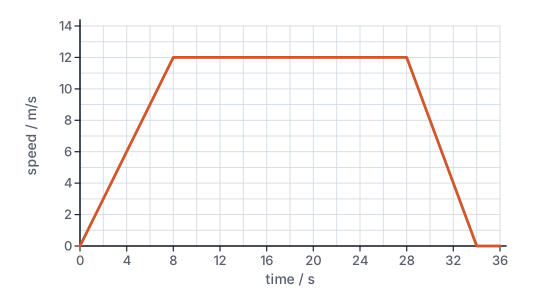
The graph shows a tram's speed between two stops. (a) Calculate its acceleration from 0 to 8 s. (b) State its acceleration from 8 s to 28 s, and explain how the graph shows it. (c) Calculate its acceleration from 28 s to 34 s, and state its deceleration. (d) The tram slows down when brake pads press on discs that turn with its wheels. Name the force between the pads and the discs, and give two things it does. (e) At a tram stop on a high bridge, a worker drops a small steel bolt from rest into the river. Ignore air resistance. Calculate its speed after 3.0 s, using g = 9.8 m/s². Would a heavier bolt be faster after 3.0 s? Explain.
Acceleration from 0 to 8 s
Acceleration from 8 s to 28 s, explained
Acceleration and deceleration from 28 s to 34 s
The force in the brakes and two things it does
The bolt's speed, and the heavier bolt
2. compare / describe / explain
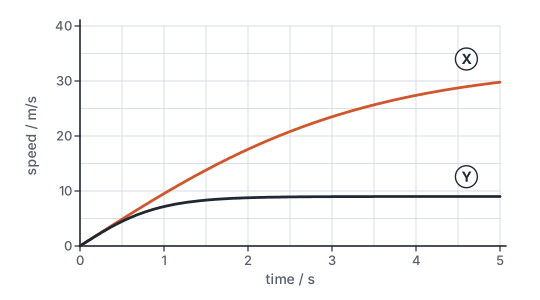
Two balls of the same size are dropped together from a high window: X is a golf ball and Y is a table-tennis ball, which is much lighter. The graph shows their speeds. (a) Compare their accelerations just after they are let go, and explain why they are almost the same. (b) Describe how the speed of Y changes from 0 to 5 s, and explain it in terms of the forces on Y. (c) Which ball has the bigger terminal velocity? Explain why. (d) Ball X is still speeding up at 5 s. What does that tell you about the forces on it? (e) The same two balls are dropped in a tall tube with all the air pumped out. Describe how their speed–time graphs would look.
Accelerations at the start, explained
How the speed of Y changes, explained
The bigger terminal velocity, explained
The forces on X at 5 s
With the air pumped out