Pupil sheet · Acceleration, falling and drag
Acceleration — questions
Name ______________________ Date ____________
Try every question before you use a nudge. Write in full sentences where you are asked to explain.
1. calculate
A cyclist speeds up steadily from 2.0 m/s to 8.0 m/s in 4.0 s. Calculate her acceleration.
Acceleration of the cyclist: ______________ unit ________
Nudge (only if you are stuck): Acceleration is the change in velocity per unit time. What is the change in speed here?
2. identify / explain
A motion sensor records the speeds of two toy cars, X and Y, every second. Which statement is correct? Then explain how the table shows it.
| time / s | car X speed / m/s | car Y speed / m/s |
|---|---|---|
| 0 | 0 | 0 |
| 1 | 1.2 | 0.4 |
| 2 | 2.0 | 0.8 |
| 3 | 2.4 | 1.2 |
| 4 | 2.6 | 1.6 |
Circle one answer.
- Both cars have a constant acceleration
- Car X has a constant acceleration; car Y's acceleration is changing
- Car Y has a constant acceleration; car X's acceleration is changing
- Car X is faster, so only car X has a constant acceleration
How does the table show which acceleration is constant?
Nudge (only if you are stuck): Write down how much each car's speed grows in each second. Are the changes the same every second?
3. calculate
The graph shows a cyclist's speed against time. Use the gradient of section A to calculate her acceleration in the first 3 s.
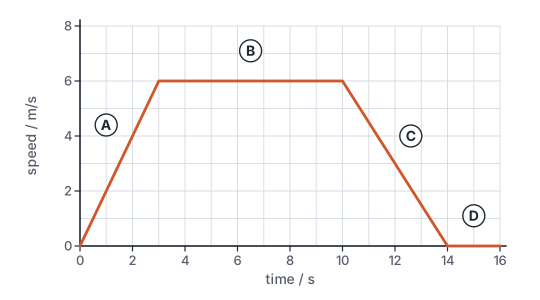
Acceleration in section A: ______________ unit ________
Nudge (only if you are stuck): Draw a triangle under section A. Read the rise (a change in speed) and the run (a change in time) from the axes.
4. calculate / describe / state
A bus slows down steadily from 15 m/s to 5.0 m/s in 4.0 s as it comes into a bus stop. (a) Calculate its acceleration. (b) The bus slows down because brake pads press on metal discs that turn with its wheels. Name the force between the pads and the discs, and give two things it does.
(a) Acceleration of the bus: ______________ unit ________
(b) The force between the pads and the discs, and two things it does
Nudge (only if you are stuck): Subtract in the order final speed − starting speed. Is the change positive or negative? In (b), think about two solid surfaces rubbing against each other.
5. calculate
A stone is dropped from rest down a deep well. The air hardly slows it, so it is in free fall. Use g = 9.8 m/s² to calculate its speed after 2.0 s.
Speed after 2.0 s: ______________ unit ________
Nudge (only if you are stuck): In free fall the speed grows by 9.8 m/s in every second. How many seconds has it been falling?
6. define / calculate / explain
(a) Define acceleration. (b) An aircraft speeds up steadily along a runway from rest to 80 m/s in 32 s. Calculate its acceleration. (c) Explain what your answer means for the aircraft's speed in each second.
Definition of acceleration
The aircraft's acceleration, with working and unit
What your answer means
Nudge (only if you are stuck): Acceleration is a change in something per unit time. In (c), think about how much the speed grows in one second.
7. identify
The graph shows a motorbike's speed against time. Match each section A to D with the motorbike's motion, using each description once.
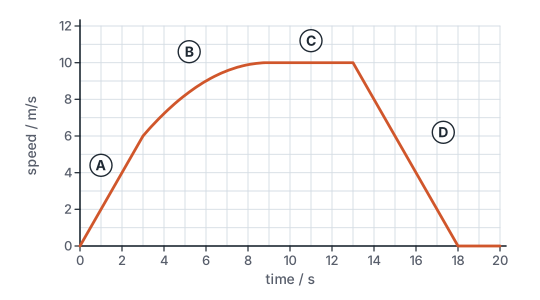
Write the number of the matching option.
- Constant acceleration
- Changing acceleration: speeding up by less each second
- Constant speed: zero acceleration
- Constant deceleration
- Section A: ______
- Section B: ______
- Section C: ______
- Section D: ______
Nudge (only if you are stuck): For each section ask: is the speed changing? Is the line straight or curved? Does it rise or fall?
8. calculate / state
The graph shows a car's speed against time. (a) Calculate the car's acceleration in section A. (b) State its acceleration in section B. (c) Calculate its acceleration in section C, and state its deceleration.
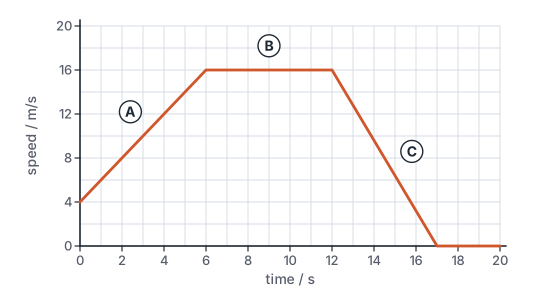
Acceleration in section A, with working
Acceleration in section B
Acceleration and deceleration in section C, with working
Nudge (only if you are stuck): For each straight section find rise ÷ run, taking the rise as final speed − starting speed. Section A does not start at zero.
9. identify / explain
A cyclist squeezes the brake levers. Rubber brake blocks press on the metal rims of the turning wheels, and the bicycle slows down from 6.0 m/s to rest. Choose every statement that is correct, then explain how the brakes slow the bicycle.
Tick every correct statement.
- Friction between the blocks and the rims acts against the motion
- The rims and the blocks get warmer
- While it slows down, the bicycle's acceleration is negative
- Friction only acts on things that are moving
- The negative acceleration means the bicycle moves backwards
How do the brakes slow the bicycle, and what else do they do?
Nudge (only if you are stuck): Two solid surfaces rub together here. What force acts between them, and what does it do to the surfaces?
10. identify / explain
Which statement about objects in free fall near the surface of the Earth is correct? Then explain why each of the others is wrong.
Circle one answer.
- A heavy object in free fall has a bigger acceleration than a light one
- All objects in free fall have the same acceleration, about 9.8 m/s²
- An object in free fall falls at a constant speed of 9.8 m/s
- The acceleration of free fall is exactly 9.8 m/s² everywhere on the Earth
Why is each of the other statements wrong?
Nudge (only if you are stuck): Remember the ball and the feather in the tube with no air, and what the unit m/s² tells you.
11. state / calculate / sketch / explain
A ball is thrown straight up at 14.7 m/s. The air hardly slows it, so on the way up its speed falls by 9.8 m/s in every second. (a) State its acceleration on the way up, taking upwards as positive. (b) Calculate how long it takes to stop rising. (c) On paper, sketch its speed–time graph from the throw until it stops rising. (d) At the top the ball is still for an instant. Is its acceleration zero there? Explain. (e) A different case: you strike a match by rubbing its head quickly along the rough side of the box, and it bursts into flame. Name the force between the head and the box, and explain both why you have to keep pushing the match and why it lights.
Acceleration on the way up, with its sign
Time to stop rising, with working
Your sketch: describe its shape and its values
Acceleration at the top, explained
Striking a match, explained
Nudge (only if you are stuck): Time = change in velocity ÷ acceleration. In (d), ask what the ball is doing just before and just after the top. In (e), think about what friction does to surfaces that rub.