Pupil sheet · Acceleration, falling and drag
Falling and drag — questions
Name ______________________ Date ____________
Try every question before you use a nudge. Write in full sentences where you are asked to explain.
1. identify / explain
Drag acts on an object that moves through a liquid or a gas. Choose every case in which drag acts on the moving object, then explain what those cases have in common.
Tick every correct statement.
- A submarine moving through the sea
- A cyclist riding along a road
- A steel ball sinking through oil
- A space probe drifting through empty space, far from any planet
- A stone falling in a tube with all the air pumped out
What do the cases with drag have in common?
Nudge (only if you are stuck): Is the object pushing its way through a liquid or a gas? If there is nothing there, can anything push back?
2. complete
Complete the sentences about a skydiver who jumps from an aeroplane. Just after she jumps, her speed is small, so the air resistance on her is ____ (1). As she falls faster, the air resistance ____ (2), so her acceleration gets smaller. When the air resistance is ____ (3) to her weight, the forces balance and she falls at a constant speed: her ____ ____ (4).
Gap 1
Gap 2
Gap 3
Gap 4
Nudge (only if you are stuck): The words you need are small, increases, equal and terminal velocity.
3. identify
A ball is dropped from the top of a tall building. The graph shows its speed as it falls. Match each point P, Q and R with the statement about the forces on the ball there.
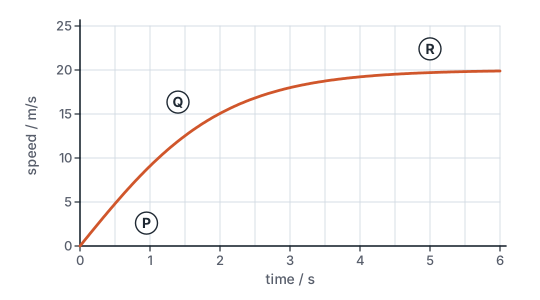
Write the number of the matching option.
- Air resistance is very small: the ball speeds up with an acceleration close to 9.8 m/s²
- Air resistance is smaller than the weight but growing: the ball speeds up by less each second
- Air resistance is equal to the weight: the ball falls at its terminal velocity
- Point P: ______
- Point Q: ______
- Point R: ______
Nudge (only if you are stuck): Look at how steep the line is at each point. Steep means a big acceleration; flat means no acceleration.
4. identify / explain
A student drops a steel ball into a tall tube of oil and times it between marks 0.10 m apart, starting well below the surface. The times are 1.42 s, 1.44 s and 1.43 s. Which statement is correct? Then explain.
Circle one answer.
- The ball is speeding up
- The ball is moving at a steady speed: its terminal velocity
- The ball is slowing down
- There is no drag on the ball
How do the times show what the ball is doing?
Nudge (only if you are stuck): If the ball were still speeding up, would each 0.10 m take more time or less than the one before?
5. calculate
A plastic bead sinks through a tall tube of syrup. Marks on the tube are 0.15 m apart, and the times from mark to mark are 3.06 s, 2.98 s and 3.02 s. Calculate the mean time for one gap, then the bead's speed.
Mean time for one gap: ______________ unit ________
Speed of the bead: ______________ unit ________
Nudge (only if you are stuck): First find the mean of the three times. Then use speed = distance ÷ time for one gap.
6. describe / explain
The graph shows the speed of a skydiver. Describe her motion in each section A to D, and explain it in terms of her weight and the air resistance on her.
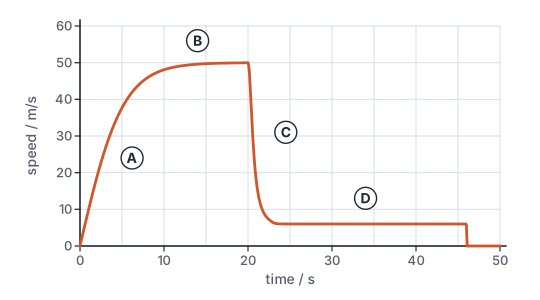
Section A
Section B
Section C
Section D
Nudge (only if you are stuck): In each section, first say whether she is speeding up, steady or slowing down. Then compare the two forces: is the air resistance smaller than, equal to or bigger than her weight?
7. identify / explain
A raindrop falls through the air at its terminal velocity. Which statement about the forces on it is correct? Then explain how you know from its motion.
Circle one answer.
- No forces act on the raindrop
- Its weight is bigger than the air resistance
- The air resistance is equal to its weight, so the forces balance
- The air resistance is bigger than its weight
How do you know from its motion?
Nudge (only if you are stuck): Is the raindrop's speed changing? What does that tell you about the two forces?
8. identify / explain
A skydiver is falling at her terminal velocity of 55 m/s when she opens her parachute. Choose every statement that is true just after it opens. Then explain why she ends up at a new, lower steady speed.
Tick every correct statement.
- The air resistance on her is bigger than her weight
- She slows down: she decelerates
- She moves upwards for a moment
- Her weight gets smaller
- As she slows down, the air resistance gets smaller
Why does she end up at a new, lower steady speed?
Nudge (only if you are stuck): What does the canopy change: her weight, or the air resistance at a given speed?
9. identify / explain
Choose every change that would make the drag on a moving object bigger. Then explain why the last statement is wrong.
Tick every correct statement.
- Moving faster
- Spreading out, or opening a parachute
- Moving through water instead of air, at the same speed
- Moving through a vacuum instead of air
- Making it heavier, with the same size and shape
Why does making the object heavier not change the drag?
Nudge (only if you are stuck): Drag comes from pushing a liquid or a gas out of the way. Which changes mean pushing more of it aside, faster, or pushing aside something thicker?
10. explain / predict / sketch
A car is driven as fast as it can go along a straight, level test track. The engine gives a forward driving force that stays the same. The friction in the wheels is small enough to ignore. The car's speed rises, then levels off at its top speed of 60 m/s. (a) Explain, using the forces on the car, why it stops speeding up. (b) The driver fits a large box on the roof. Predict what happens to the top speed, and explain. (c) On paper, sketch the car's speed–time graph from rest to its top speed, with and without the roof box.
Why the car stops speeding up
The top speed with the roof box, explained
Your sketch: describe both curves
Nudge (only if you are stuck): This is like terminal velocity, but along the ground: which force does the job that the weight does for a falling skydiver?