Pupil sheet · Gas pressure and temperature
Gas pressure and temperature — final check
Name ______________________ Date ____________
Work alone, with the lesson closed. Answer every question; there are no hints.
1. explain / show / calculate / describe / state
The graph shows how the pressure of the air in a sealed syringe changes with its volume, at a constant temperature. (a) Explain, in terms of particles and the force on each unit of area, why the pressure at B is higher than at A. (b) Use the values at A and B to show that pV is constant. (c) Calculate the volume of the air when its pressure is 150 kPa. (d) Describe the graph you would get by plotting p against 1/V for these readings. (e) State the two conditions needed for pV to stay constant.
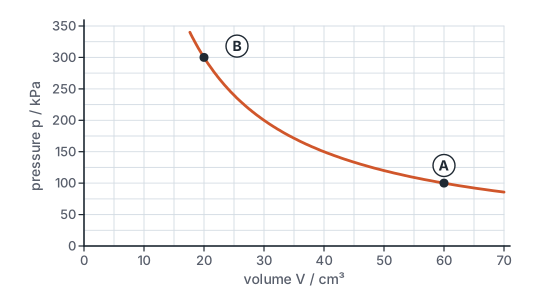
Why the pressure is higher at B
pV at A and at B
Volume at 150 kPa
The graph of p against 1/V
The two conditions
2. describe / explain / calculate / estimate
A rigid metal can of air is sealed, and its pressure is measured at five temperatures. (a) Describe how the pressure changes with the temperature, and explain this in terms of the particles. (b) Convert 90 °C into kelvin. (c) A pupil says: “From 30 °C to 60 °C the temperature doubles, so the pressure doubles.” Use the table to show that she is wrong. (d) The pattern in the table carries on to colder temperatures. Estimate the temperature, in °C, at which the pressure would reach zero, and give this temperature in kelvin. (e) A gas is cooled to 250 K. What is this temperature in °C?
| θ / °C | p / kPa |
|---|---|
| 30 | 100 |
| 45 | 105 |
| 60 | 110 |
| 75 | 115 |
| 90 | 120 |
How the pressure changes, and why
90 °C in kelvin
Why the pupil is wrong
Where the pressure would reach zero, in °C and K
250 K in °C
3. explain / state / describe
A steel road bridge is 200 m long. (a) Explain why it is built with expansion joints at its ends: gaps bridged by metal teeth that can slide between each other. (b) A pupil says: “When the bridge expands on a hot day, the particles of steel get bigger.” Explain what really happens to the particles. (c) Equal volumes of iron, ethanol (a liquid) and air are warmed by 50 °C (the air free to expand, so its pressure stays the same). State which expands most and which expands least. (d) Explain your answer to (c) in terms of the arrangement and motion of the particles and the forces between them. (e) A bimetallic strip is made of copper and iron joined along their length; copper expands more than iron. It is clamped at its left end, with the copper on top. Describe which way its free end moves when it is heated, and explain why.
Why the bridge has expansion joints
What happens to the particles
Most and least expansion
The order explained
The copper and iron strip