Pupil sheet · Gas pressure and temperature
Heating a gas at a fixed volume — questions
Name ______________________ Date ____________
Try every question before you use a nudge. Write in full sentences where you are asked to explain.
1. identify / explain
A sealed metal can of air is heated. Its volume stays the same. Which of these happen to the particles of air inside the can? Choose all that are correct, then explain how your choices make the pressure rise.
Tick every correct statement.
- They move faster
- They hit the walls more often
- They hit the walls harder
- They get bigger
- There are more of them
- They move closer together
How do your choices make the pressure rise?
Nudge (only if you are stuck): Heating changes one thing about each particle. Which of the statements follow from that one change?
2. calculate
Use T (in K) = θ (in °C) + 273. (a) Convert 27 °C into kelvin. (b) Convert 400 K into °C.
(a) 27 °C in kelvin: ______________ unit ________
(b) 400 K in °C: ______________ unit ________
Nudge (only if you are stuck): A temperature in kelvin is always 273 more than the same temperature in °C. Which way do you go in each part?
3. complete
Complete the sentences. A sealed glass bottle of air is put in a fridge; its volume does not change. As the air cools, its particles move more ____ (1). They hit the walls less ____ (2) and less hard, so the ____ (3) on each unit of area of the walls gets smaller: the pressure ____ (4).
Gap 1
Gap 2
Gap 3
Gap 4
Nudge (only if you are stuck): Cooling is heating backwards. What happens to the speed of the particles?
4. identify / explain
A fixed mass of gas is kept at a constant volume, and its pressure is measured at five temperatures. Which statement is correct? Then explain, in terms of the particles, why the pressure rises.
| θ / °C | p / kPa |
|---|---|
| 0 | 91 |
| 25 | 99 |
| 50 | 108 |
| 75 | 116 |
| 100 | 124 |
Circle one answer.
- The pressure is proportional to the temperature in °C
- The pressure rises by about the same amount for each 25 °C rise in temperature
- The pressure doubles when the temperature rises from 50 °C to 100 °C
- The pressure stays the same, because the volume is fixed
Why does the pressure rise? Explain in terms of the particles.
Nudge (only if you are stuck): Work out the rise in pressure for each 25 °C step. Are the rises about the same?
5. deduce / state
The graph shows the pressure of a fixed mass of gas in a sealed metal flask, measured at six temperatures. Carry the line on towards colder temperatures, with a ruler on paper or by eye. At what temperature, in °C, would it reach zero pressure? Then state this temperature in kelvin.
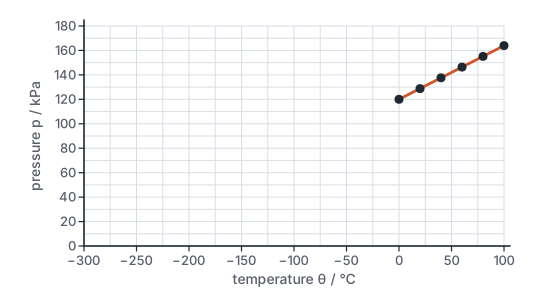
Temperature at which the line reaches zero pressure: ______________ unit ________
What is this temperature in kelvin?
Nudge (only if you are stuck): Each 100 °C colder takes about 44 kPa off. How many of these steps take 120 kPa down to zero?
6. identify
Match each temperature in °C to the same temperature in kelvin.
Write the number of the matching option.
- 273 K
- 373 K
- 0 K
- 310 K
- 37 K
- −546 K
- 0 °C: ______
- 100 °C: ______
- −273 °C: ______
- 37 °C: ______
Nudge (only if you are stuck): T (in K) = θ (in °C) + 273, also for temperatures below 0 °C.
7. explain
A driver checks the air pressure in her car tyres on a warm afternoon, and again early the next morning after a frosty night. The tyres do not leak, and their volume hardly changes, but the pressure is lower in the morning. Explain why, in terms of the particles of air in the tyres.
Nudge (only if you are stuck): What did the frosty night do to the air in the tyres, and so to the speed of its particles?
8. predict / explain
A flask of air is sealed so that its volume cannot change. Its pressure is 100 kPa at 20 °C, 107 kPa at 40 °C and 114 kPa at 60 °C. Predict its pressure at 100 °C.
Pressure at 100 °C: ______________ unit ________
Nudge (only if you are stuck): How much does the pressure rise for each 20 °C? How many more 20 °C steps are there from 60 °C to 100 °C?
9. explain / calculate / estimate
A table-tennis ball has a dent in it but no hole. It is dropped into water at 70 °C, and after a few seconds the dent pops out. (a) Explain, in terms of the particles of the air inside the ball, why the dent pops out. (b) Convert 20 °C and 70 °C into kelvin. (c) A pupil says: “70 °C is 3.5 times 20 °C, so the air in the ball pushes 3.5 times as hard.” Explain why this is wrong. (d) Air in a rigid flask is at 100 kPa at 20 °C, and its pressure rises by about 7 kPa for every 20 °C. Estimate its pressure at 70 °C.
Why the dent pops out
20 °C and 70 °C in kelvin
What is wrong with “3.5 times”
Pressure at 70 °C, with working
Nudge (only if you are stuck): In (a), the ball is sealed: what changes about the air particles when it warms? In (c), what is the pressure of a gas at 0 °C? In (d), how many steps of 20 °C are there from 20 °C to 70 °C?