Pupil sheet · Gas pressure and temperature
Thermal expansion — questions
Name ______________________ Date ____________
Try every question before you use a nudge. Write in full sentences where you are asked to explain.
1. identify / explain
A metal ball, a flask of water at room temperature and the air in a balloon are all warmed (the water not as far as boiling), and then left to cool again. Which statements are correct? Choose all that are correct, then explain what happens to the particles when each one gets bigger.
Tick every correct statement.
- The metal ball expands
- The water expands
- The air in the balloon expands
- When they cool again, all three contract
- The particles in each one get bigger
- The mass of each one increases
What happens to the particles when each one gets bigger?
Nudge (only if you are stuck): Thermal expansion happens in solids, liquids and gases. What changes about the particles, and what does not?
2. complete
Complete the sentences. A cold metal ball just fits through a metal ring. When the ball is heated in a flame, it ____ (1), so it no longer fits through. Its particles ____ (2) more about their fixed positions and end up a little further ____ (3). When the ball cools, it ____ (4) and fits through the ring again.
Gap 1
Gap 2
Gap 3
Gap 4
Nudge (only if you are stuck): Use the words for getting bigger and getting smaller with temperature, and what particles in a solid do when they are warmed.
3. identify / explain
Overhead power cables hang lower between the pylons on a hot summer day than on a cold winter day. Which is the reason? Then explain why the cables are put up with some slack instead of being pulled tight.
Circle one answer.
- The cables expand in the heat, so they are longer and sag more
- The cables get heavier when they are hot
- The cables contract in the heat
- The pylons get shorter in the heat
Why are the cables put up with some slack?
Nudge (only if you are stuck): What happens to the length of a metal cable when it warms, and when it cools?
4. identify / explain
Equal volumes of iron, water and air are warmed by the same amount (the air free to expand, so its pressure stays the same). Put them in order, from the one that expands most to the one that expands least. Then explain the order in terms of the forces between the particles.
Write the number of each step in order.
- Iron (a solid)
- Air (a gas)
- Water (a liquid)
- Expands most: ______
- In the middle: ______
- Expands least: ______
Explain the order in terms of the forces between the particles.
Nudge (only if you are stuck): Think of the 1000 cm³ of steel, water and air warmed from 20 °C to 100 °C: about 3, 40 and 270 cm³.
5. identify / explain
The diagram shows a fire alarm. When it gets hot, the bimetallic strip must bend up and touch the contact, so that the bell rings. One layer of the strip is brass and the other is steel; brass expands more than steel. Which layer must be the brass? Then explain how this makes the strip bend up.
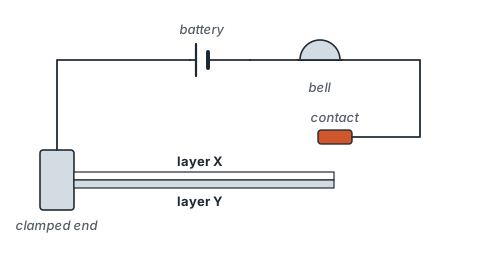
Circle one answer.
- X, the upper layer
- Y, the lower layer
- Either layer: a heated strip always bends up
- Neither: both layers must be the same metal
Explain how the order of the layers makes the strip bend up.
Nudge (only if you are stuck): A heated bimetallic strip curls with the metal that expands more on the outside of the curve. For the free end to go up, which side must be on the outside?
6. explain
A metal lid is screwed tightly onto a glass jar of jam, and it will not turn. After hot water has been run over the lid for a minute, it unscrews easily. Explain why.
Nudge (only if you are stuck): Both the lid and the jar get warmer. Which one gets bigger by more?
7. explain
A steel block and the air in a balloon are warmed by the same amount; the air stays at the same pressure. Explain, in terms of the arrangement and motion of their particles and the forces between them, why the air expands much more than the steel.
Nudge (only if you are stuck): Compare how close the particles are, how they move, and how strongly they are held, in a solid and in a gas.
8. identify / explain
The bulb of a liquid-in-glass thermometer is put into warm water, and the thread of liquid rises up the tube. Which statement explains why? Then explain why the tube inside a thermometer is made very narrow.
Circle one answer.
- The liquid expands more than the glass, so it has to go up the tube
- The glass contracts and squeezes the liquid up the tube
- The particles of the liquid get bigger
- The liquid expands less than the glass, so it is pushed up the tube
Why is the tube made very narrow?
Nudge (only if you are stuck): Both the liquid and the glass get warmer. Which expands more? Then think about where the extra volume of liquid has to go.
9. explain / suggest / describe
A driver fills her car's steel fuel tank to the brim with cold fuel early on a summer morning, then parks in the sun. By the afternoon, some fuel has dripped out of the tank's overflow pipe. (a) Explain why the fuel overflowed, even though the steel tank also got warmer. (b) Explain, in terms of particles, why the fuel expands more than the steel. (c) Suggest what the driver should do next time, and say why it works. (d) A sealed, rigid metal can of air lies in the same car. Its air cannot expand at all. Describe and explain what happens to the air in the can instead.
Why the fuel overflowed
Why the fuel expands more than the steel
What the driver should do, and why
What happens in the sealed can
Nudge (only if you are stuck): Compare how much a liquid and a solid expand for the same rise in temperature. In (d), the particles still speed up: if the gas cannot spread out, what happens to the hits on the walls?