Pupil sheet · Specific heat capacity
Specific heat capacity — final check
Name ______________________ Date ____________
Work alone, with the lesson closed. Answer every question; there are no hints.
1. determine / calculate / identify / describe / explain
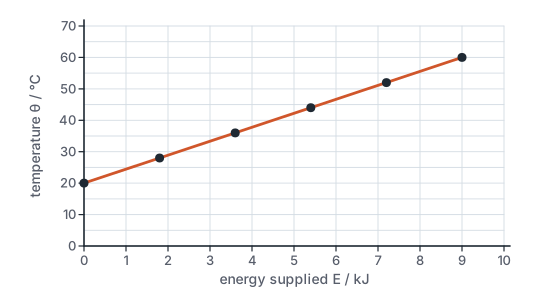
A 0.50 kg block of an unknown metal, in an insulating jacket, is heated from 20 °C. The graph shows how its temperature changes with the energy supplied. (a) Use the graph to find the rise in temperature when 9.0 kJ has been supplied. (b) Calculate the specific heat capacity of the metal. (c) Identify the metal, using these values: copper 390 J/(kg °C), iron 450 J/(kg °C), aluminium 900 J/(kg °C). (d) Describe what happens to the internal energy of the block and to its particles as it warms. (e) Describe how the shape of the graph would change if the block were heated without its jacket, and explain why.
(a) Rise in temperature
(b) Specific heat capacity
(c) The metal
(d) Internal energy and particles
(e) Without the jacket
2. state / calculate / explain / describe
A pupil heats 200 cm³ of water in a polystyrene cup with a lid, and records the joulemeter reading and the temperature. (a) State the mass of the water in kilograms. (b) Use the readings at 0 kJ and 8.8 kJ to calculate the specific heat capacity of water. (c) The book value is 4200 J/(kg °C). Explain why the pupil’s value is higher. (d) Describe how the method would change to measure the specific heat capacity of a solid metal block instead. (e) Explain, using specific heat capacity, why hot-water bottles are filled with water.
| energy supplied / kJ | temperature / °C |
|---|---|
| 0 | 18.0 |
| 2.2 | 20.5 |
| 4.4 | 23.0 |
| 6.6 | 25.5 |
| 8.8 | 28.0 |
(a) Mass of the water
(b) Specific heat capacity
(c) Why the value is higher
(d) For a solid block
(e) Hot-water bottles