Pupil sheet · Specific heat capacity
Heating a block of aluminium — questions
Name ______________________ Date ____________
Try every question before you use a nudge. Write in full sentences where you are asked to explain.
1. identify / explain
Two aluminium blocks have the same mass. Block A is at 20 °C and block B is at 60 °C. Which statement is correct? Then explain your choice.
Circle one answer.
- They have the same internal energy, because they have the same mass
- Block A has more internal energy, because its particles are packed more tightly
- Block B has more internal energy, because its temperature is higher
- Neither block has any internal energy until it is heated
Why?
Nudge (only if you are stuck): Think about what happens to the energy you supply when you heat a block, and what a higher temperature tells you about its particles.
2. complete
Complete the sentences. When a block of aluminium is heated, its temperature rises and its ____ (1) energy increases. Its particles stay in their fixed positions, but they ____ (2) about them faster. A rise in temperature means an increase in the average ____ (3) energy of all the particles. When the block cools again, its particles move ____ (4) on average, and its internal energy decreases.
Gap 1
Gap 2
Gap 3
Gap 4
Nudge (only if you are stuck): Which word describes the motion of particles that are held in fixed positions? Which kind of energy does a moving thing have?
3. calculate
A 0.500 kg block of copper is heated from 20.0 °C to 50.0 °C. The joulemeter shows that 5.85 kJ of energy was supplied, and none of it escaped. Calculate the specific heat capacity of copper.
Specific heat capacity of copper: ______________ unit ________
Nudge (only if you are stuck): Change kJ into J and work out the rise in temperature first. Then use c = ΔE / (mΔθ).
4. describe
A pupil measures the specific heat capacity of an aluminium block, using an immersion heater, a thermometer and a joulemeter. Put the steps of the method in order. The steps are listed in a mixed order.
Write the number of each step in order.
- Read the final temperature and work out the rise in temperature
- Weigh the block on a balance
- Switch on and heat until the joulemeter shows the chosen energy, then switch off
- Put the heater and the thermometer in their holes, set the joulemeter to zero and read the starting temperature
- Step 1: ______
- Step 2: ______
- Step 3: ______
- Step 4: ______
Nudge (only if you are stuck): You need three measurements: the mass, the energy and the rise in temperature. Which of them must you take before any energy goes in?
5. calculate
The base of a copper saucepan has a mass of 250 g. Calculate the energy needed to warm it from 20 °C to 120 °C. The specific heat capacity of copper is 390 J/(kg °C). Give your answer in joules.
Energy needed: ______________ unit ________
Nudge (only if you are stuck): Change the mass into kilograms and find the rise in temperature. Then use ΔE = mcΔθ.
6. calculate
A 2.00 kg block of iron at 20.0 °C is given 27.0 kJ of energy by a heater, and none of it escapes. The specific heat capacity of iron is 450 J/(kg °C). Calculate (a) the rise in temperature of the block and (b) its final temperature.
(a) Rise in temperature: ______________ unit ________
(b) Final temperature: ______________ unit ________
Nudge (only if you are stuck): Rearrange the equation: Δθ = ΔE / (mc). Is Δθ the final temperature?
7. identify
In the equation c = ΔE / (mΔθ), match each symbol to what it stands for and its unit.
Write the number of the matching option.
- the energy required per unit mass per unit temperature increase, in J/(kg °C)
- the energy supplied, in J
- the mass, in kg
- the rise in temperature, in °C
- the temperature at the end, in °C
- the internal energy of the block, in J
- ΔE: ______
- m: ______
- Δθ: ______
- c: ______
Nudge (only if you are stuck): Δ means “a change in”. Which quantity is measured with a balance, which with a joulemeter, and which with a thermometer?
8. determine / explain
The graph shows the readings for a 1.00 kg aluminium block with nothing round it, heated from room temperature, 20.0 °C, with 30.0 kJ. Use the graph to find (a) the rise in temperature during the first 15 kJ and (b) the rise in temperature during the last 15 kJ. Then explain why the two rises are different.
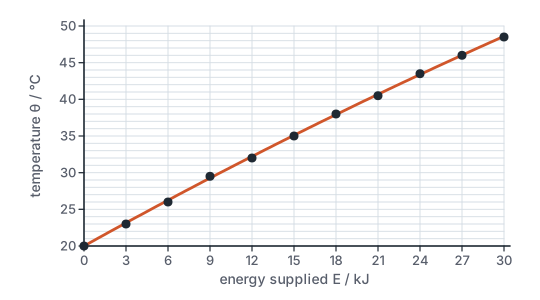
(a) Rise during the first 15 kJ: ______________ unit ________
(b) Rise during the last 15 kJ: ______________ unit ________
Why is the second rise smaller?
Nudge (only if you are stuck): Read the temperature at 0, 15 and 30 kJ. Energy escapes from the block to the air: when does more of it escape?
9. identify / explain
A pupil heats a bare 1.00 kg aluminium block and calculates its specific heat capacity as 1050 J/(kg °C). The book value is 900 J/(kg °C). Which of these help to explain why the measured value is too high? Choose all that apply, then explain how they make the value too high.
Tick every correct statement.
- Some energy escaped from the warm block to the air
- Some energy warmed the heater and the thermometer, not the block
- The block lost mass as it was heated
- The thermometer could only be read to the nearest 0.5 °C
- The particles of aluminium got bigger as the block warmed
How do your choices make the measured value too high?
Nudge (only if you are stuck): c = ΔE / (mΔθ), and the joulemeter counts all the energy supplied. Which reasons make Δθ smaller than it should be?
10. explain / describe
A pupil says: “When a metal block is heated, its particles get bigger, and that is why its temperature rises.” Explain what is wrong with this, and describe what really happens to the particles and to the internal energy of the block.
Nudge (only if you are stuck): Think about what the magnifier showed: did the particles change size, or did they change how they move?
11. calculate / explain / predict / suggest
When a car brakes hard, its steel brake disc warms up. A disc of mass 5.0 kg takes in 450 kJ of energy during one stop. The specific heat capacity of steel is 450 J/(kg °C). (a) Calculate the rise in temperature of the disc, assuming none of the energy escapes. (b) Explain, in terms of particles, what has happened to the internal energy of the disc. (c) A heavier disc of 10 kg takes in the same energy. Predict its rise in temperature, and say why a heavier disc may be better. (d) In a laboratory, a pupil measures the specific heat capacity of a steel sample as 520 J/(kg °C). Suggest why the value is higher than 450 J/(kg °C), and one way to improve the measurement.
(a) Rise in temperature
(b) Internal energy and particles
(c) The 10 kg disc
(d) Why 520, and one improvement
Nudge (only if you are stuck): For (a), Δθ = ΔE / (mc), with the energy in joules. For (d), follow the energy the joulemeter counted: did it all warm the steel?