Pupil sheet · Specific heat capacity
Measuring the specific heat capacity of water — questions
Name ______________________ Date ____________
Try every question before you use a nudge. Write in full sentences where you are asked to explain.
1. state
1 cm³ of water has a mass of 1 g. A pupil measures out 250 cm³ of water. State the mass of the water (a) in grams and (b) in kilograms.
(a) Mass in grams: ______________ unit ________
(b) Mass in kilograms: ______________ unit ________
Nudge (only if you are stuck): Each cubic centimetre of water is 1 g. Then 1000 g = 1 kg.
2. identify / explain
When measuring the specific heat capacity of water, a pupil stirs the water gently all the time while it is heated. What is the main reason for stirring? Then explain why it matters for the measurement.
Circle one answer.
- To make the water heat up faster
- So that all the water is at the same temperature as the thermometer
- To stop the water boiling
- To add energy to the water
Why does it matter?
Nudge (only if you are stuck): The thermometer measures the temperature only where its bulb is. Do you need the temperature of one part of the water, or of all of it?
3. describe
A pupil measures the specific heat capacity of water in a lagged beaker, using an immersion heater, a thermometer and a joulemeter. Put the steps of the method in order. The steps are listed in a mixed order.
Write the number of each step in order.
- Set the joulemeter to zero, switch on and stir the water gently
- Measure out 1000 cm³ of water (1.00 kg) and pour it into the lagged beaker
- Switch off when the joulemeter shows 30.0 kJ, stir, and read the highest temperature
- With the power off, put the heater and the thermometer into the water, terminals above it, and read the starting temperature
- Step 1: ______
- Step 2: ______
- Step 3: ______
- Step 4: ______
Nudge (only if you are stuck): Safety first: when must the power be off? And which reading must you take before any energy goes in?
4. calculate
200 g of water is heated in a polystyrene cup. The joulemeter shows 8.4 kJ, and the temperature rises from 20.0 °C to 30.0 °C. Calculate the specific heat capacity of water from these results.
Specific heat capacity of water: ______________ unit ________
Nudge (only if you are stuck): Change 8.4 kJ into J and 200 g into kg, and find the rise. Then use c = ΔE / (mΔθ).
5. identify
Match each job to the best material. Use the specific heat capacities given, and think about how hot each material must get.
Write the number of the matching option.
- water (4200 J/(kg °C))
- copper (390 J/(kg °C))
- dense bricks (about 800 J/(kg °C))
- polystyrene (a good insulator)
- dry sand (about 830 J/(kg °C))
- The coolant that carries energy away from a car engine: ______
- A saucepan base that should warm up quickly: ______
- The core of a storage heater, heated to several hundred °C overnight: ______
Nudge (only if you are stuck): A coolant must carry away a lot of energy for each degree it warms. A saucepan base should warm up with little energy. A storage heater core is heated far above 100 °C.
6. calculate
A kettle holds 1.50 litres of water at 20 °C. Calculate the energy needed to bring the water to 100 °C, assuming none escapes. Give your answer in kJ. (1 litre = 1000 cm³; 1 cm³ of water has a mass of 1 g; the specific heat capacity of water is 4200 J/(kg °C).)
Energy needed: ______________ unit ________
Nudge (only if you are stuck): Find the mass in kilograms first: 1.50 litres = 1500 cm³. Then use ΔE = mcΔθ, and change J into kJ at the end.
7. identify / explain
On a sunny day, dry sand on a beach gets much hotter than the sea, although both receive about the same energy from the Sun on each square metre. Which statement explains this using specific heat capacity? Then explain it, comparing the values: dry sand about 830 J/(kg °C), water 4200 J/(kg °C).
Circle one answer.
- Sand has a lower specific heat capacity, so the same energy gives each kilogram a bigger rise in temperature
- Sand has a higher specific heat capacity, so it takes in more energy
- Water loses more energy to the air than sand does
- The sea is heavier than the sand, so it needs more energy
Compare the two values.
Nudge (only if you are stuck): A low specific heat capacity means little energy is needed for each degree. Which material has the lower value?
8. calculate
A heater supplies 21 kJ to 1.00 kg of water, and then the same energy to a 1.00 kg block of copper. None of the energy escapes. Calculate the rise in temperature of (a) the water and (b) the copper. Specific heat capacities: water 4200 J/(kg °C), copper 390 J/(kg °C).
(a) Rise in temperature of the water: ______________ unit ________
(b) Rise in temperature of the copper: ______________ unit ________
Nudge (only if you are stuck): Use Δθ = ΔE / (mc), with ΔE in joules, once for each material.
9. calculate / identify
Two liquids, P and Q, are heated in turn in the same lagged beaker with the same heater. There is 0.500 kg of each, and each starts at 20 °C. One of them is water (4200 J/(kg °C)). The graph shows the results. Calculate the specific heat capacity of the other liquid. Then say which liquid is water, and how the graph shows it.
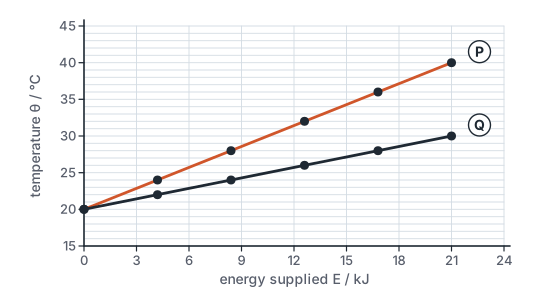
Specific heat capacity of the other liquid: ______________ unit ________
Which liquid is water, and how does the graph show it?
Nudge (only if you are stuck): Read the rise of each liquid at 21 kJ. Which rise fits 0.500 kg of water? Then use c = ΔE / (mΔθ) for the other liquid.
10. explain / suggest
A pupil heats 1.00 kg of water in a glass beaker with no lagging and no lid, and calculates its specific heat capacity as 5100 J/(kg °C). Explain why this value is higher than 4200 J/(kg °C), and suggest two improvements to the method.
Nudge (only if you are stuck): Follow the energy the joulemeter counted: did it all warm the water? Then think of ways to keep more of it in.
11. explain / calculate / predict / describe
A car engine is cooled by water pumped through it. (a) Explain why water is a good coolant. (b) In one minute, 5.0 kg of water flows through the engine and warms from 80 °C to 90 °C. Calculate the energy it carries away. (c) A hot 1.0 kg block of aluminium at 80 °C is dropped into 1.0 kg of water at 20 °C in an insulated container. Predict whether the final temperature will be nearer 20 °C or nearer 80 °C, and explain why, using the specific heat capacities of aluminium (900 J/(kg °C)) and water (4200 J/(kg °C)). No calculation is needed. (d) A company invents a new coolant liquid. Describe how you would measure its specific heat capacity, and state one safety precaution.
(a) Why water is a good coolant
(b) Energy carried away
(c) Nearer 20 °C or 80 °C, and why
(d) Method and a safety precaution
Nudge (only if you are stuck): For (b), ΔE = mcΔθ. For (c), the energy the aluminium gives out is the energy the water takes in: which one’s temperature changes more for each joule?