Stir a spoonful of salt into a pan of soup and watch it go: the white crystals shrink, and after a few seconds you can't see any salt at all. Yet the soup tastes saltier, so the salt can't have left the pan. Where is it? In this part you'll learn how to describe what is in a beaker, even when some of it is out of sight. At the end of the experiment the salt comes back as white crystals, and that is the best evidence that it never left.
One substance, or a mixture?
Start with three jars: one of pure water, one of pure salt (sodium chloride, the salt you put on food) and one of iron filings. Each jar holds only one substance, so each is a pure substance. The size of the sample doesn't matter: a drop of pure water and a bucket of it both contain water and nothing else.
Now tip some salt and some sand into one dish. Two substances share the dish, so you have a mixture, and each substance in it is a component. Add more sand or less salt and it's still a mixture, because a mixture has no fixed recipe. The two substances aren't joined to each other, either, so each one keeps its own properties: the sand is still gritty, and the salt still dissolves in water.
Trap: “Pure orange juice must be a pure substance.” On a label, pure means that nothing has been added. In chemistry, pure means one substance only. Orange juice contains water, sugars and many other substances, so it's a mixture.
Pure water is a pure substance too, even though water, H2O, is a compound: hydrogen and oxygen chemically joined, always in the same ratio. Stir salt into it and you have a mixture, and evaporating the water gets the salt back. But no filtering or evaporating can split the water itself into hydrogen and oxygen, because those two are joined, not just mixed.
A mixture can look like one liquid
Before you stir, you can see salt crystals in the water. Afterwards you can't. Does that prove that the salt has gone?
It doesn't. The salt dissolves: it breaks up into particles far too small to see, and they spread out, or are dispersed, through the water. The result is a solution, a mixture in which one substance is dissolved in another. Both substances are still there; you just can't see one of them any more. That's why the soup tastes salty.
Every solution is a mixture, but not every mixture is a solution. Stir sand into water and the grains don't dissolve: they swirl around for a moment and then settle on the bottom. Sand and water make a mixture, but the sand isn't dissolved, so the whole thing isn't a solution.
Evenly mixed, or separate parts?
Take a spoonful from the top of a well-stirred salt solution and another from the bottom. Both spoonfuls hold the same proportions of water and salt, because the dissolved salt has spread evenly through all of the water. A mixture that is the same all the way through is a homogeneous mixture: its composition (what it contains, and in what proportions) is uniform, the same everywhere. Sugar fully dissolved in water is homogeneous, and so is copper(II) sulfate solution. It's blue, but it's the same blue everywhere, so the dissolved substance is spread evenly too.
Now let sand settle in water. Would a spoonful from the bottom hold the same as a spoonful from the top? No: the bottom one is full of grains, and the top one has none. A mixture whose parts have different compositions is a heterogeneous mixture. Shaking it only moves the grains around for a while. They don't dissolve, so as soon as you stop, they settle again.
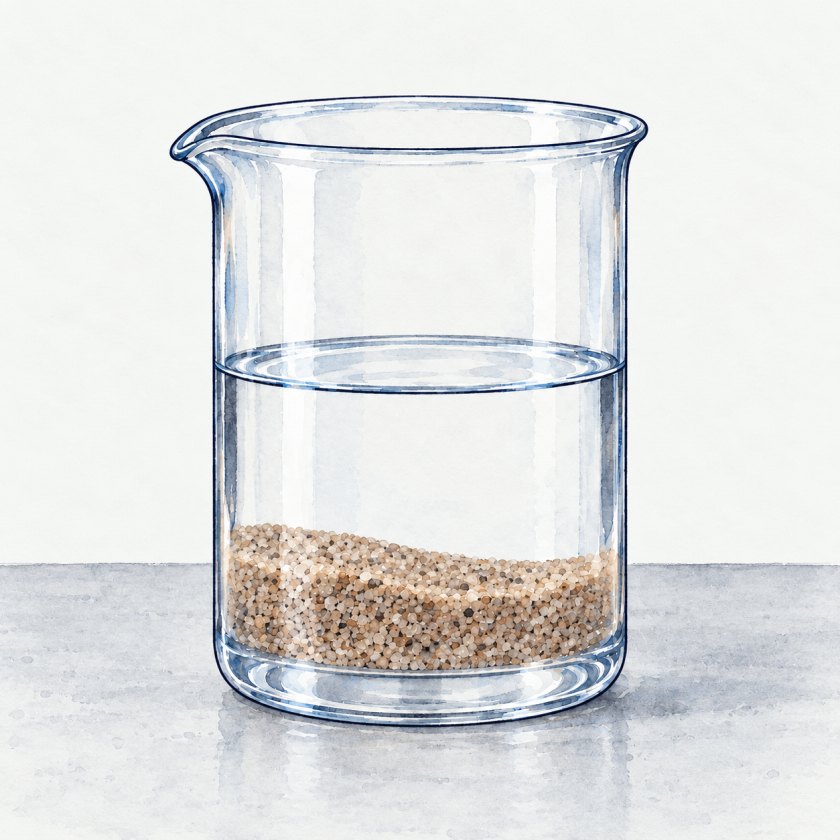
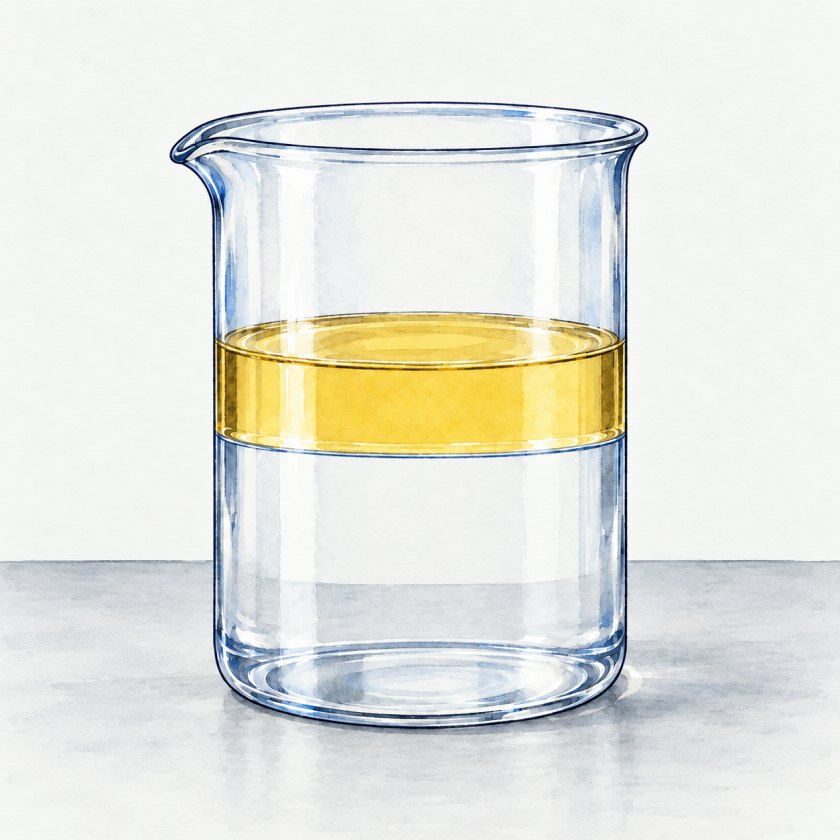
Oil and water give the same clue with two liquids. Leave them to stand and the oil floats as a layer on top of the water, so a sample from the top layer is different from one taken lower down. That makes oil and water a heterogeneous mixture too.
So you can sort any sample with two questions. First, how many substances are present? One means pure; more than one means a mixture. Then, for a mixture: is it the same all the way through, or are there separate parts? The same throughout means homogeneous, and separate parts mean heterogeneous.
Trap: “Pure water is a homogeneous mixture because it looks the same all the way through.” A mixture needs at least two substances, and pure water has only one. So pure water is a pure substance, not a mixture of any kind.
Try it now: take a mixture card, decide whether the mixture is homogeneous or heterogeneous, then turn the card over to check your reason.
Take a mixture. Make a choice.
Is it the same all the way through, or are there separate parts? Think of your reason, then choose.
One picture.
Two possible answers.
What is your reason?
A reminder before choosing
A homogeneous mixture is the same all the way through. A heterogeneous mixture has separate parts, such as grains or layers, that hold different things. Every card here shows a mixture. Pure water has only one substance, so it isn’t a mixture of either kind.
Say your reason first, then choose: your choice turns the card over, so you can compare your reason with the explanation on the back. Judge the whole sample, including any separate grains or layers.
Three samples: what you see and what is inside
Look at the stripes behind these three beakers. Can you see them through every liquid? Before you read the labels, predict which samples are pure.
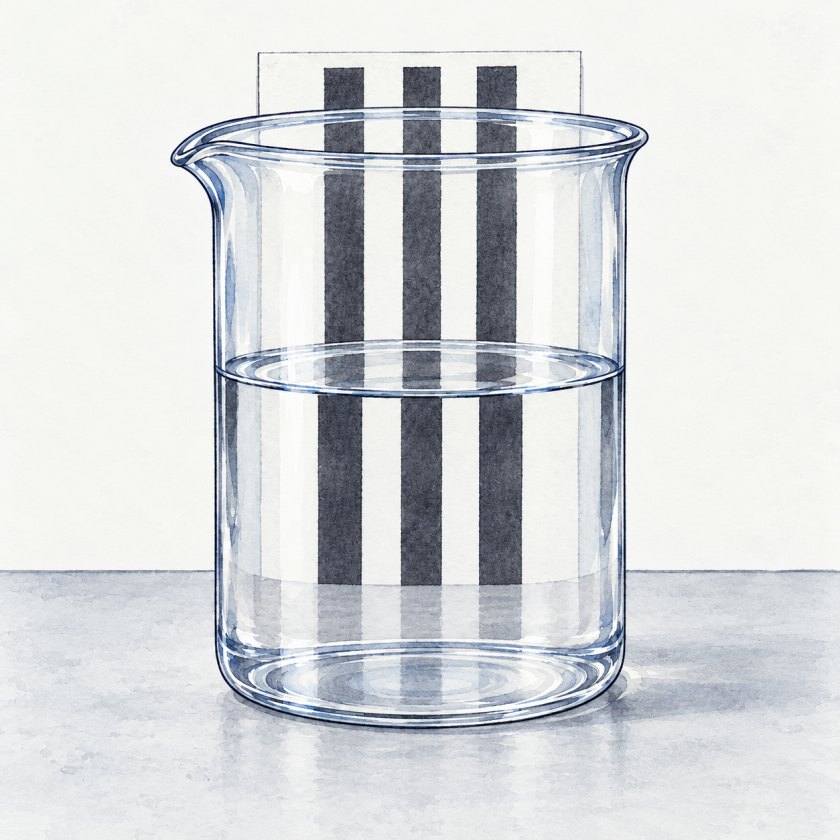
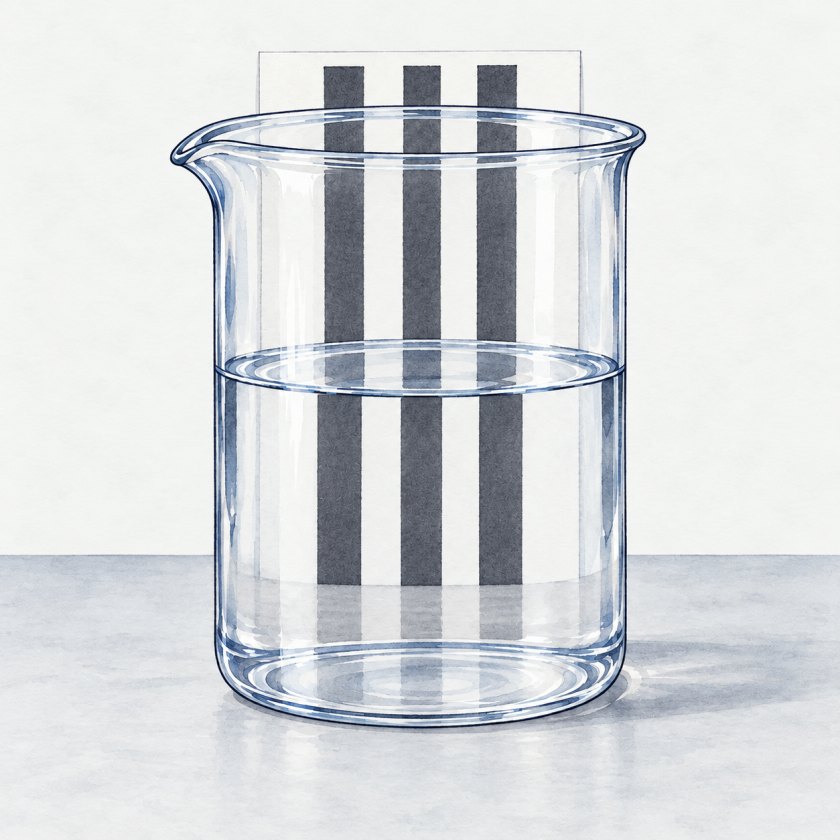
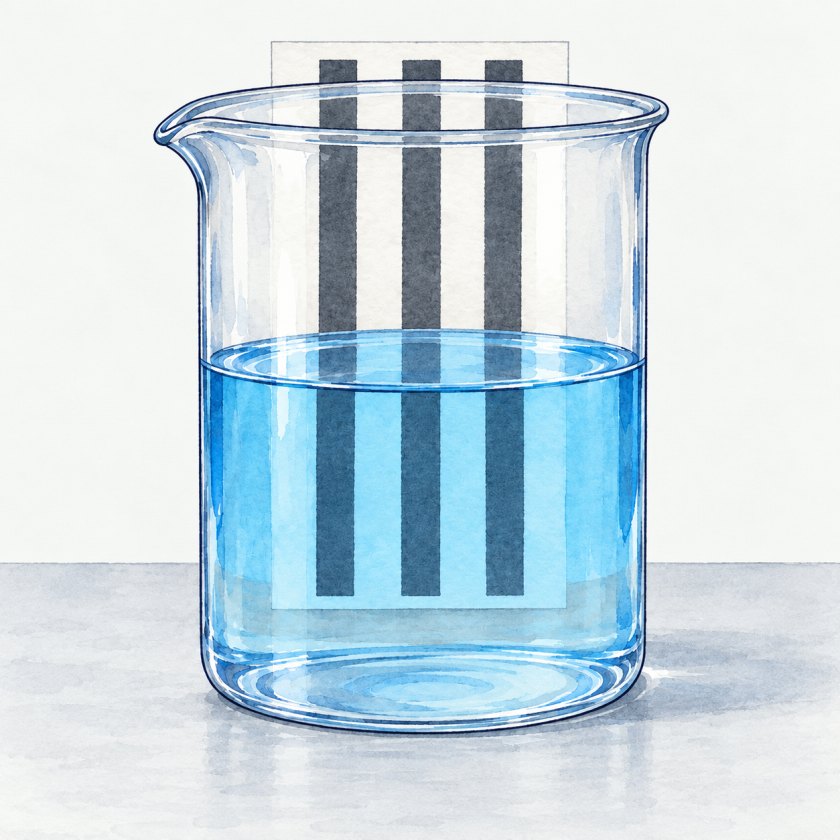
- Clear means you can see through it: it isn't cloudy. All three liquids are clear.
- Colourless means it has no colour. The first two are colourless; the third is blue.
- Pure says what is inside: one substance only. Only the first sample is pure.
The first two pictures look the same on purpose, because pure water and salt solution really do look the same. Only their labels tell them apart. That's why you can't tell from its appearance whether a clear, colourless liquid is pure: looking shows you what you can see, not everything that is inside.
Trap: “A blue liquid can't be a solution.” Dissolved copper(II) sulfate makes a clear blue solution: you can see through it, and the colour is the same all the way through. A colour doesn't mean that there are grains in the liquid. Pure substances can have a colour too: pure copper is reddish-brown.
In the experiment, you'll see the salt go into the water. When you get it back at the end, that shows it was in the clear liquid all along.
Three names for three different things
When salt dissolves in water, each part has its own name. The water is the solvent: the substance that the salt dissolves in. The salt is the solute: the substance that dissolves. The solution is both of them together, so calling the salt alone “the solution” leaves the water out of the story.
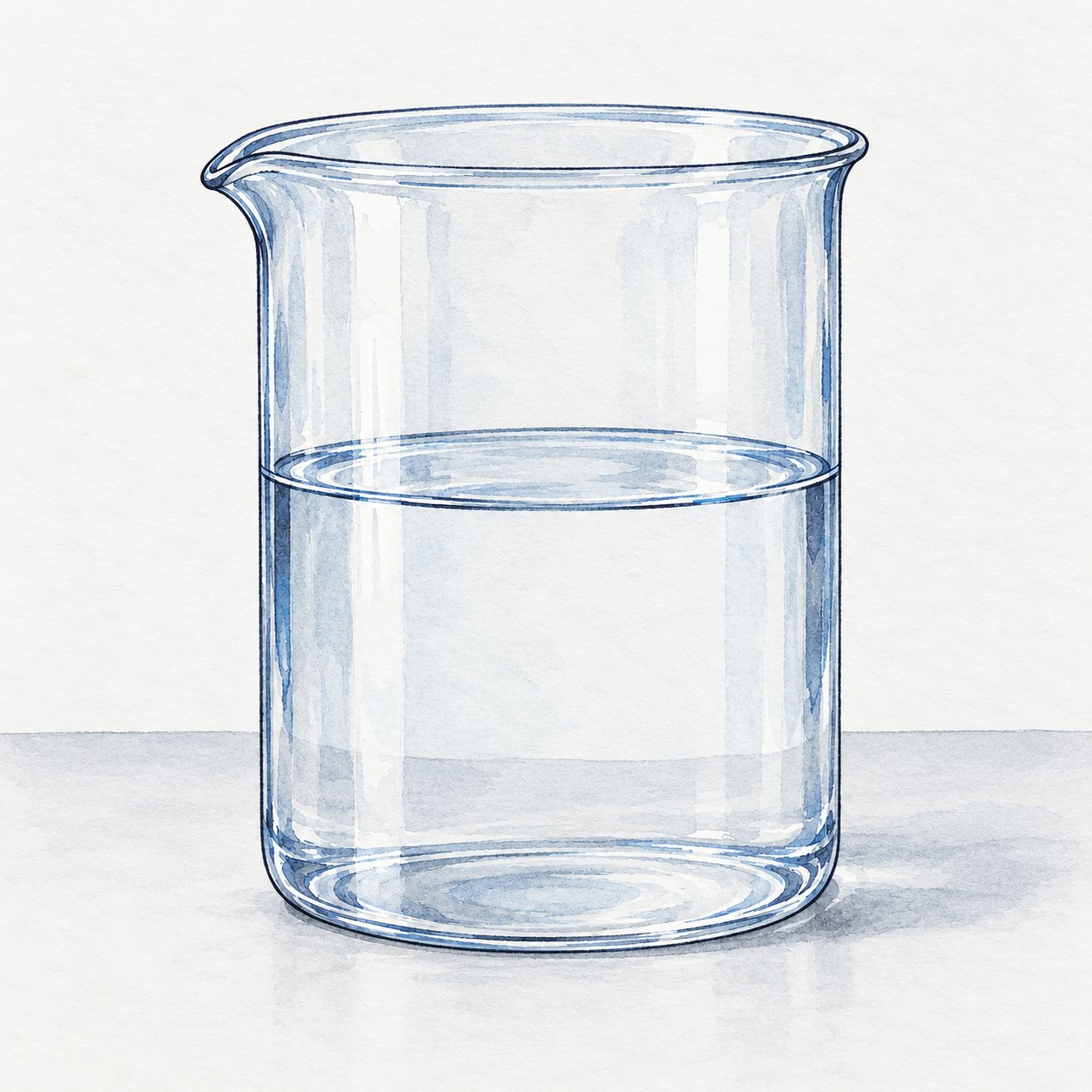
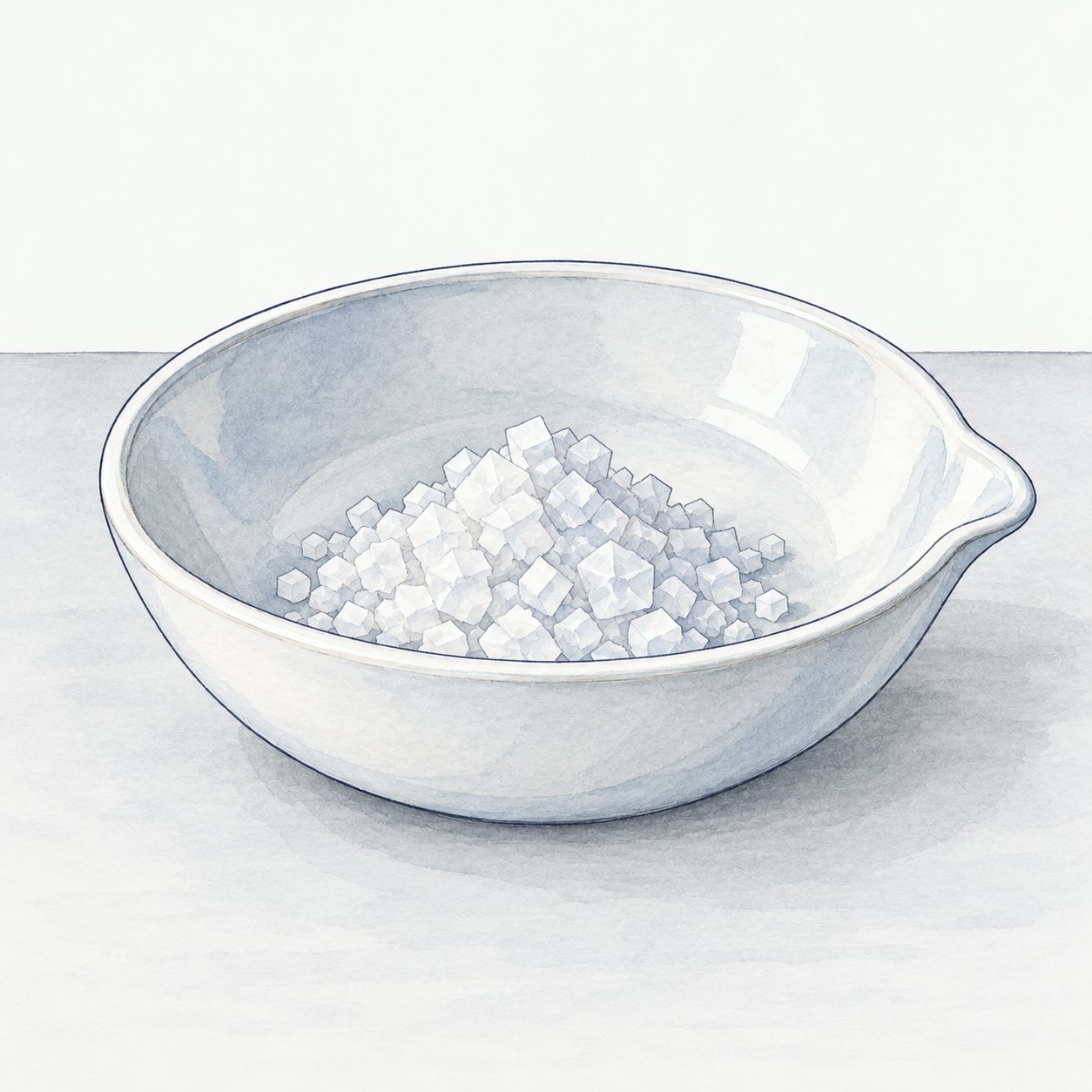
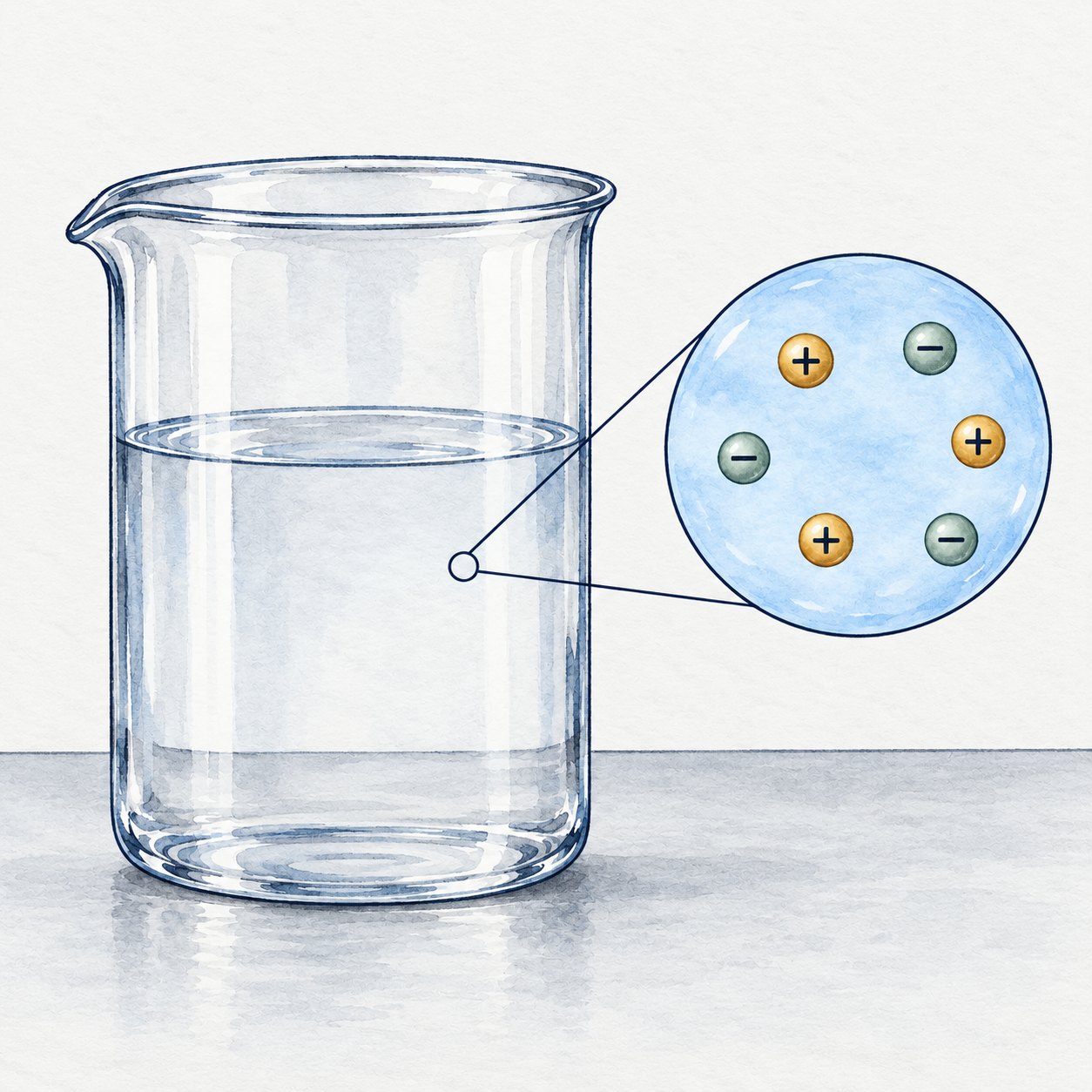
In the enlargement, blue shading marks the water, although real salt water is colourless. The + and − symbols stand for the salt's particles. Dissolved salt is there as tiny charged particles called ions, not as miniature crystals floating out of sight. The sizes and numbers in the drawing aren't real.
The names describe the job that each substance does, so they work for any solution, and the solvent needn't be water. If a note says that iodine dissolves in ethanol, then ethanol is the solvent, because it's the substance the iodine dissolves in: you don't need a test to know that.
A solute doesn't have to start as a solid, either. A fizzy drink has carbon dioxide gas dissolved in it. You can't see the gas while it is dissolved, but bubbles appear when some of it comes back out.
One beaker, three substances
The experiment starts with a beaker of iron filings, sand and salt, all dry and mixed together. Instead of picking out grains by hand, you'll use the ways in which the three substances differ. Iron is attracted to a magnet; sand and salt aren't. So a magnet collects the iron and leaves the sand and salt behind. It's inside a plastic bag, so the filings slide off it afterwards.
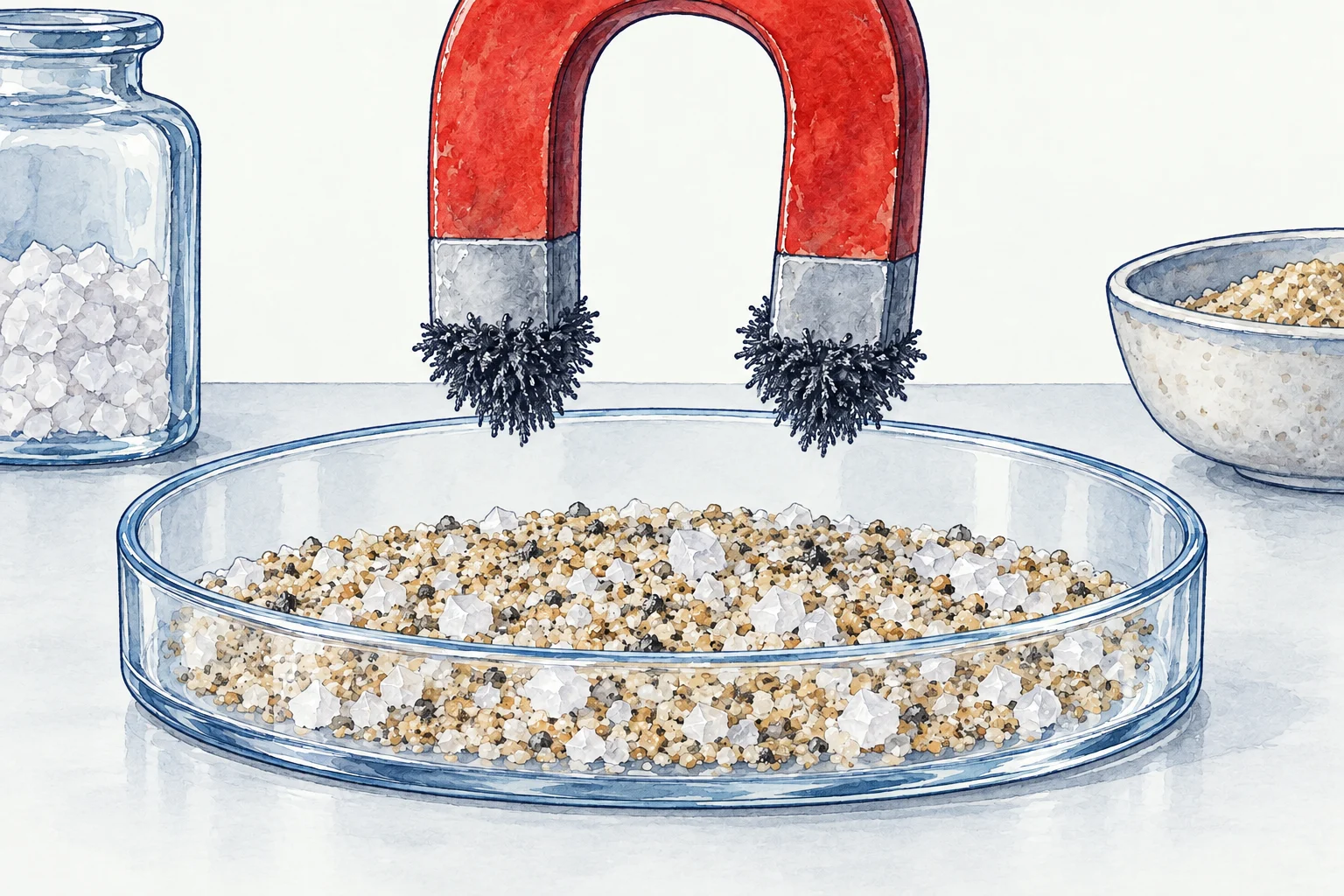 (enlarge)
Every separation in this topic works like that: a difference in properties sends one component one way and the others another way.
The crystals disappear. The salt stays.
Next, you add water and stir. The salt dissolves, so it's soluble in water. The sand stays as grains however long you stir, because it's insoluble in water. That difference is what you'll use next: in part 2, a filter holds back the sand and lets the salt solution through.
Trap: “The salt melted.” Melting is a solid turning into a liquid of the same substance, and it needs heat: salt melts at about 800 °C. Here the salt spreads out through a different substance, the water, at room temperature. It hasn't turned into water, and it hasn't made a separate liquid layer.
Worked example
What is in the beaker now?
You start with iron, sand and salt. You collect the iron with the magnet, then add enough water to dissolve all the salt, and stir. What is in the beaker now?
Sand and salt solution. The liquid around the grains is homogeneous, because the dissolved salt has spread evenly through the water. The beaker as a whole is heterogeneous, though, because the sand grains are a separate part. The iron isn't in the beaker any more: it's on its own watch glass. Filtering can now hold back the sand and let the salt solution pass into the beaker below.
Worked example
Sugar changes the example, not the roles
You stir a little sugar into water until it all dissolves. Which is the solvent, and which is the solute?
The sugar dissolves in the water, so sugar is the solute and water is the solvent. Together they make sugar solution. None of this depends on the solute being salt: you find the roles by asking what dissolves in what.
Your turn
Try the questions before you open any help. In your answers, finish this thought: “The crystals can't be seen any more, but the salt is still there because …”. Then point to the solvent, the solute and the whole solution.
One question draws mixtures as a component map, with a key that says which symbol stands for which component. The symbols are only labels, not pictures of real particles, so their shapes, sizes and numbers don't matter: count the different components, and check whether one is dissolved in another.
Case closed
- Only one substance? It's a pure substance.
- More than one? It's a mixture, and each substance is a component.
- Is the mixture the same all the way through? It's homogeneous. Does it have separate parts? It's heterogeneous.
- One substance dissolved in another? That's a solution: the solvent and the dissolved solute together.
- Clear, colourless and pure answer three different questions: can you see through it, has it got a colour, and how many substances are inside?
- The salt that disappeared into the water is still there. In part 3 you'll get it back.
About this model
The experiment always adds enough water for all of the salt to dissolve. The sizes of the grains, the amounts that move and the timing are chosen so that you can see them, not measured. The written cases in the questions don't add new substances to the experiment. Saturation, concentration calculations and measured laboratory yield come in later lessons. Never taste laboratory samples: pure doesn't mean safe. Real heating is done with a teacher's supervision, and you should never heat an unknown sample.
Scope: Cambridge IGCSE Chemistry 0620, 2026–2028 v 2, 12.1.3(a–c), with introductory support for the mixture/compound distinction in 2.1.1. This does not complete 2.1.1. Official syllabus, pages 13 and 37. Examples and questions are original course material.