After a swim in the sea, lie in the sun until you're dry, and your skin feels gritty. Look closely and you'll see tiny white specks: salt. The seawater had salt dissolved in it, the water evaporated into the air, and the salt was left behind on your skin. In this part you'll get the salt back from the filtrate in the same way. Then you'll use what you know about dissolving to choose a liquid that splits another pair of solids.
Let one component leave
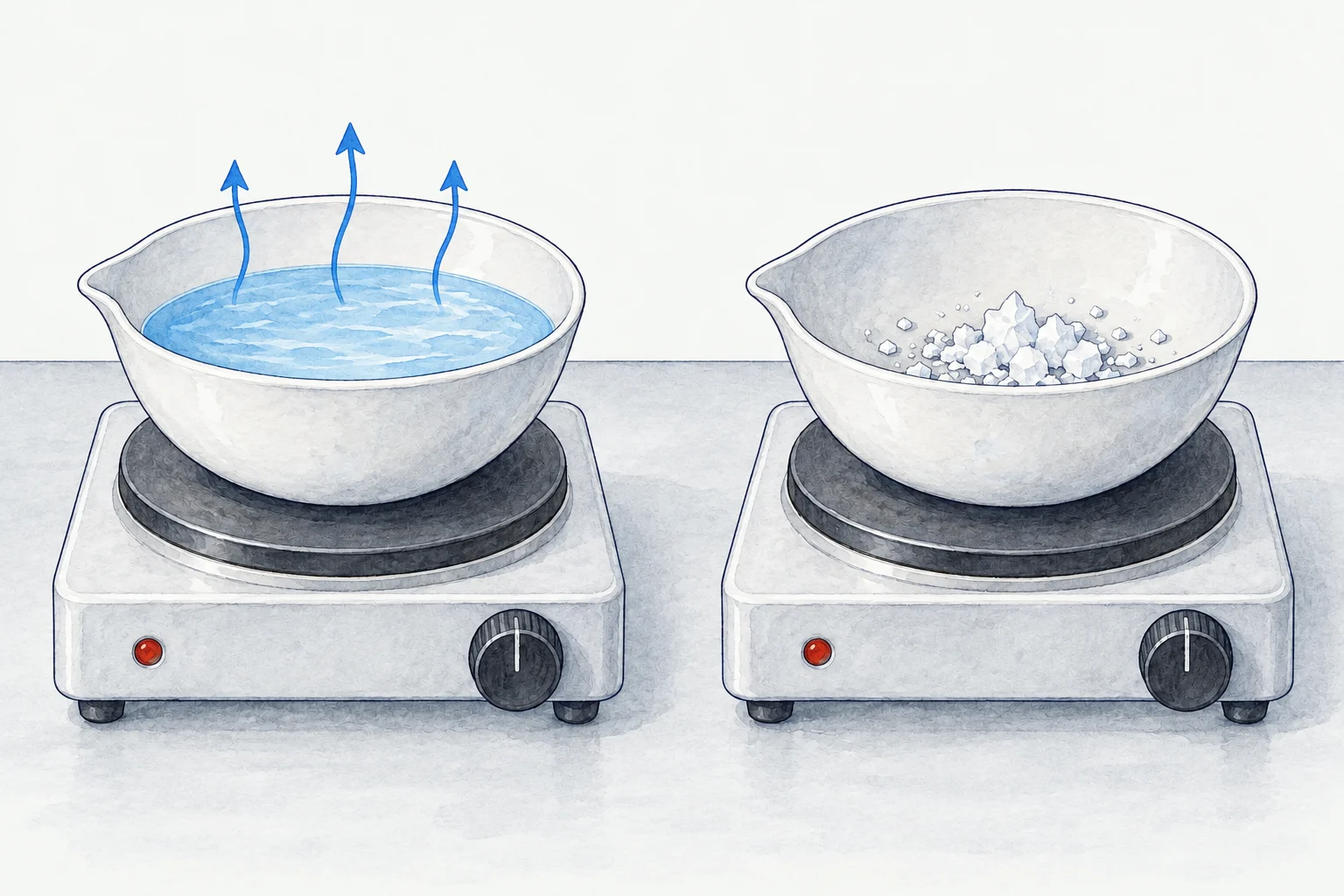
In the experiment, the filtrate goes into a porcelain evaporating basin on a hotplate. Its wide, shallow shape gives the liquid a large surface, and that helps the water leave. Before you heat it, predict: what will be left in the basin once all the water has gone? Nothing, white salt, or sand and salt?
When the basin is heated, the water leaves as water vapour, a gas. The salt doesn't go with it, because salt is non-volatile: at these temperatures it doesn't turn into a gas. So all of the salt stays in the basin, in less and less water. In the end there isn't enough water left to keep it dissolved, and white crystals appear on the porcelain.
Evaporation is a liquid turning into a gas at its surface. Heating makes it faster, but water also evaporates without heating, and without boiling: that's why your skin dries in the sun, and why puddles disappear after rain. Water vapour is invisible. The white mist you sometimes see above hot water is something different: tiny droplets of liquid water, which form when the vapour cools in the air.
 (enlarge)
Worked example
Has anything been destroyed?
Only the salt solution goes into the basin. All of its water is removed, and none of the salt is lost or chemically changed. Where is everything at the end?
- Salt: in the basin, as the solid left after evaporation. It's the residue of this separation.
- Water: in the air, as water vapour.
- Iron: still on its watch glass. Sand: still on the filter paper.
Trap: “Heating made new salt.” The salt was in the solution all along: you saw it go in. Removing the water just made it visible again.
If you weighed the open basin and its contents while it was heated, the reading would go down. That doesn't mean that matter was destroyed. The balance weighs only what is inside the basin: that's the boundary of your measurement. The water has crossed that boundary into the air, so the balance no longer counts it. Count that water too, and nothing is missing: matter is conserved.
What if you want the water back as well? An open basin can't give you that, because the vapour escapes into the room. You need apparatus that cools the vapour and collects it as a liquid, and you'll meet it in Distillation.
When heating is the wrong choice
Salt survives heating unchanged, but not every solute does. Some substances decompose when they're heated strongly: they break down into new substances. Sugar is one: heat it to dryness and it turns brown, then black. If a solute decomposes, heating its solution to dryness leaves a solid, but not the substance you wanted. So a solid in the basin doesn't always mean that you've got the original solute back. You need to know that the solute is stable when it's heated, and if a question doesn't tell you that, don't plan to heat it.
Heating to dryness isn't the full crystallisation method, either. In crystallisation, you heat a solution only until it's saturated, let it cool so that crystals grow, then filter the crystals off and dry them. You'll learn it in the next topic, Crystallisation.
Real heating needs a teacher-approved method and eye protection. Heat gently, because the last of the water can spit hot salt out of the basin. Stop when the first crystals appear, and the rest of the water evaporates by itself. A basin can still be hot when it looks cool. Never heat an unknown liquid, or a solvent that can catch fire.
Choose a liquid that splits the pair
Think back to the sand and salt. Water was the right liquid because it dissolves the salt and not the sand, so it sent the two solids different ways: the salt into the filtrate, and the sand onto the paper. Now suppose that two other solids share a dish. To separate them by dissolving and filtering, you need a liquid that does the same job.
A suitable solvent dissolves one of the solids and leaves the other undissolved. Dissolving only one of them is called selective dissolving. If the liquid dissolves both, both pass through the paper together, in the filtrate. If it dissolves neither, both stay together on the paper, as the residue. Either way, the two solids are still mixed.
So a note that says a liquid dissolves one of the solids isn't enough on its own: you also need to know that it leaves the other one undissolved. Check two more things as well. The liquid mustn't react with either solid, or you won't get them back unchanged. And it must be safe to use and to remove.
Worked example
Which liquid sends X and Y different ways?
You want X and Y separately, and here are the facts you can use. None of the liquids reacts with X or Y, so you'll get both back unchanged. Filter paper holds back grains of Y. And when the water is removed by the teacher-approved method, X stays in the basin, because it doesn't change or turn into a gas.
| Candidate | X dissolves? | Y dissolves? |
|---|---|---|
| Water | Yes | No |
| J | Yes | Yes |
| K | No | No |
Choose before you read on. Which liquid sends X and Y different ways?
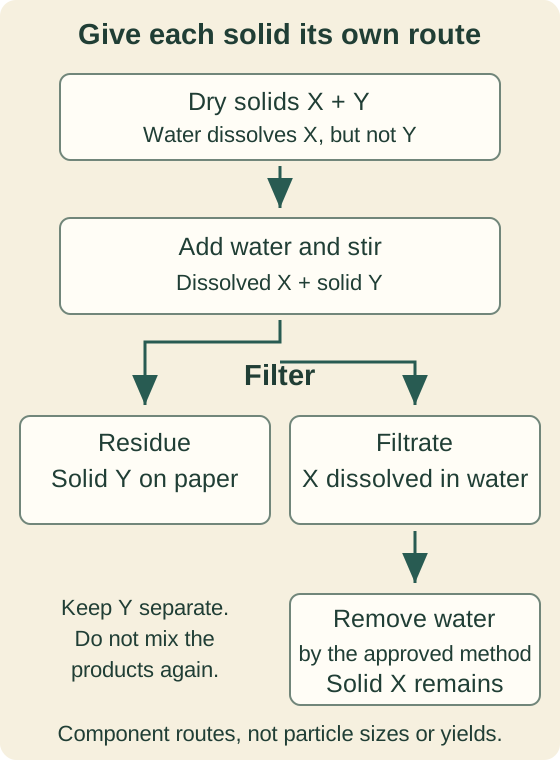
Water. Add enough of it and stir: X dissolves, and Y stays as grains. Filter, and Y is collected on the paper while X goes through in the filtrate. Then remove the water from that filtrate, in its own basin, by the approved method, and X is left behind.
J dissolves both solids, so both would go through the paper together. K dissolves neither, so both would stay on the paper. Neither of them splits the pair by this method.
 (enlarge)
Case closed
- Evaporation removes the solvent as vapour and leaves a non-volatile solute behind. The salt was there all along.
- Count the water that left as vapour, and no matter has been destroyed.
- Heating to dryness only works if the solute survives being heated.
- To split two solids by dissolving and filtering, choose a liquid that dissolves only one of them and reacts with neither.
Try the questions. Use the properties you're given, rather than guessing from the names, and follow both solids to the end. Later, come back to solvent choice with this table closed.
About this model
The table gives made-up data for a written case: it doesn't describe real substances called X, Y, J or K. Real products may need washing and drying by an approved method. The experiment moves every bit of material perfectly, so it can't show the exact yield or prove that a purification method works, and it doesn't measure the temperature or how fast the water evaporates.
Scope: 12.4.1(a), supporting 12.1.3(e), evaporation and conservation. Cambridge 0620 syllabus, pages 37–38. Full crystallisation, distillation and saturation calculations need later lessons.