You put your socks on before your shoes. Try it the other way round and the shoes are in the way, so the socks can't go on: each step only works because the step before it has set it up. Separations are the same. In the experiment, you'll plan the order of the stages yourself for a second portion, a second beaker of the same mixture. But what if the next sample is already wet, has no iron in it, or you need a different product? In this part you'll build a plan from the properties of what you actually have, instead of replaying the same recipe.
Three questions before you reach for apparatus
Before you choose any apparatus, ask yourself three things. What is present now? Which products do you want? And which property can send one component somewhere different from the rest?
| What you're told | What to do | Why it separates them |
|---|---|---|
| Only one component is attracted to the magnet | Collect it with the magnet | The other components stay behind |
| One solid dissolves; the other doesn't | Dissolve, then filter | One goes into the solution; the paper holds back the other |
| The paper holds back the undissolved grains | Filter | The grains stay on the paper; the solvent and the dissolved solute pass through |
| The solute survives heating and doesn't turn into a gas | Evaporate the solvent from the filtrate | The solvent leaves; the solute stays in the basin as the residue |
Use only the properties that you're given, and don't invent missing ones. Check that the liquid doesn't react with the solids, that the paper retains the grains, and that each product survives being recovered. These are the methods you've learned so far, not every method for every mixture.
Worked example
Separate two dry solids
You want two dry solids, A and B, separately, and here are the facts you can use. A dissolves in water, but B doesn't, and filter paper holds back grains of B. Neither of them reacts with water, so both come back unchanged. And when the water is removed by the teacher-approved method, A stays in the basin, because it doesn't change or turn into a gas.
What has to happen before the filter can split them?
Add enough water and stir, so that A dissolves. Now filter: B stays on the paper, and A passes through with the water. Then remove the water from that filtrate, in its own basin, by the approved method, and A is left behind.
Each step gives one component a different destination. If you filtered the dry powder straight away, both solids would stay on the paper, because neither of them would be dissolved yet: the difference in solubility only helps once there's water. In real work, B might also need washing and drying by a teacher-approved method.
Worked example
The right steps in the wrong order
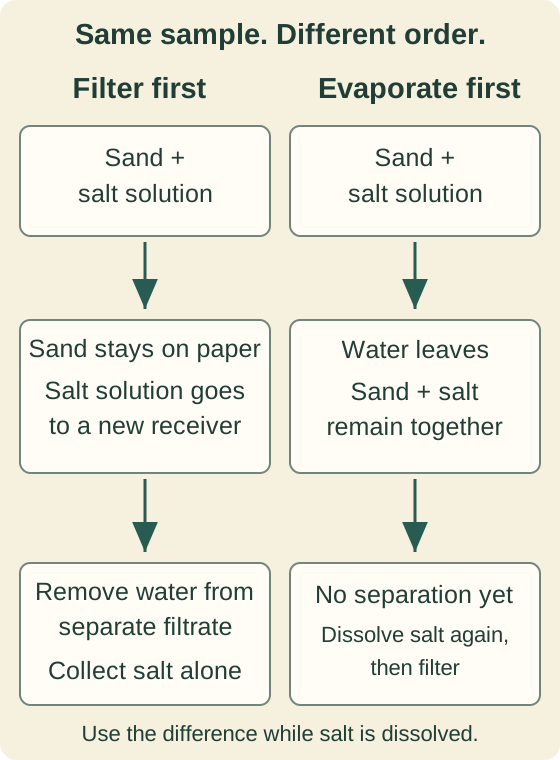
A pupil dissolves the salt in a sand-and-salt mixture, then evaporates the water before filtering. Predict what is left in the basin.
Sand and salt, mixed together again. While the salt was dissolved and the sand wasn't, a filter could have separated them. Once the water had gone, both were solids again, so that difference was lost before it could be used.
 (enlarge)
So filter while the salt is dissolved: the sand stays on the paper, and the salt solution goes into a separate receiver. Only then remove the water, from that filtrate.
If the wrong evaporation has already happened, you can still save the plan, as long as the salt hasn't changed. Add water again, stir to dissolve the salt, and then filter.
Trap: “The same steps work in any order.” A useful difference may exist at only one stage, such as the salt being dissolved while the sand isn't. Separate the components while that difference still exists.
The magnet comes first in the experiment for the same kind of reason. While the mixture is dry, the iron filings lift out cleanly. Once water is added, wet sand sticks together and clings to the filings, so the magnet would lift lumps of sand with the iron.
Notice when the starting point has changed
Suppose that the sample you're given is already sand in salt solution. Then start with the filter. The salt is already dissolved, so it doesn't need dissolving again, and there's no iron, so you don't need a magnet. Adding more water might help for some other reason, but “the old recipe had water in it” isn't a reason.
Decide what you actually need, too. If you only want the sand, you don't need to get the salt back from the filtrate at all. And if a product would decompose when it's heated, choose a method that doesn't heat it: filter the wet sample as it is, instead of heating everything to dryness first.
If facts are missing, say which ones you need. Does the liquid react with the solids? Will the paper retain the grains? Will the solute survive being recovered? An unknown liquid isn't safe just because it dissolves something.
Make your explanation as clear as your plan
“Use a filter” only names a piece of apparatus. A full answer says what goes in, what stays on the paper, what passes through, and why each component goes where it does. Your answer needs those links, not a page of extra words.
Try the planning and fault-finding questions. After all four parts, take the whole final check before you open any solutions. Later, use the recall questions with this page closed.
Case closed
- Start from the sample you actually have, not the one in the last recipe.
- Choose a difference in properties that gets you the products you want.
- Use each difference while it still exists, keep the products in separate containers, and check where every component ends up.
About this model
The experiment's account of where each component goes is ideal: it doesn't promise pure products or 100% recovery. This pilot supports a limited choice of method in 12.4.2, using 12.4.1(a–b) and 12.1.3(a–c,e–f). It doesn't complete chapter 12: mixtures of two liquids that dissolve in each other, solutes that heat damages, chromatography and full crystallisation come in later lessons.