Make coffee with a paper filter and look at what is left behind: a soggy heap of brown grounds on the paper. The grounds can't get through. Yet the coffee that drips into the cup is brown and tastes of coffee, so something from the grounds did get through: the substances that dissolved in the hot water. A filter sorts things by whether they are dissolved, not by whether they started as a solid. In this part you'll follow every component of the mixture through a filter, and decide exactly what the liquid below contains.
Follow the liquid, not just the grains
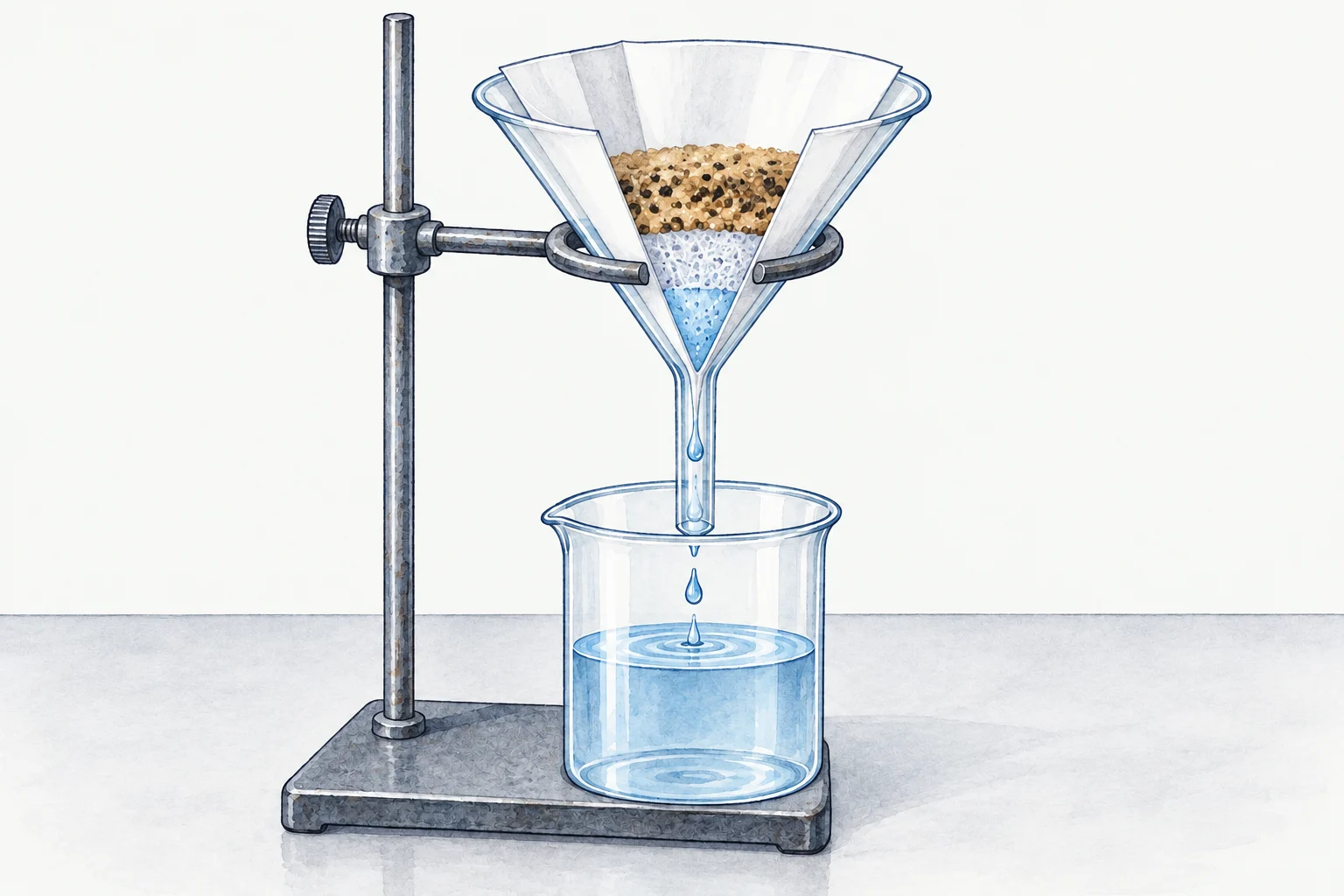
At this point in the experiment, the iron is already on its watch glass. The salt has dissolved in the water, and the sand is still there as grains. Next, everything goes into a filter: a cone of filter paper in a funnel, with an empty beaker underneath to collect what comes through. That beaker is the receiver.
Before you pour, predict: what will drip through into the receiver? Pure water, salt solution, or muddy water with sand in it?
Try it now: make your prediction, then pour the mixture into the filter. The round magnifier on the bench looks down into the beaker. Once you pour, it looks into the funnel, and the drawing in the card shows the filter paper close up, with white circles for water particles and small purple squares for the dissolved salt's particles. The colours only tell the particles apart.
What the paper holds back
Filter paper is a mat of thin fibres with tiny gaps between them. The gaps are far too small for grains of sand, so the paper holds the sand back, or retains it. Water particles are much smaller than the gaps, so they pass straight through. The dissolved salt goes with them, because it's spread through the water as separate particles that are tiny too. There are no salt crystals left for the paper to catch.
 (enlarge)
That's why filtering can separate an insoluble solid from a liquid, but can't separate a dissolved solute from its solvent.
Two products, two names
The sand left on the paper is the residue: the material left behind after a separation. The name describes what happened to it, not what it is made of, so you'll meet a different residue in part 3, when water evaporates and leaves salt behind. The salt stays behind because it is non-volatile: when the water is heated, the salt doesn't turn into a gas.
The liquid that has passed through the paper into the receiver is the filtrate. Here, the filtrate is salt solution: water and dissolved salt together.
The mixture you pour into the filter has a name too: it's the feed. Liquid that is still waiting above the paper is part of the feed, not filtrate yet, because it hasn't passed through the paper.
Worked example
Keep track of every component
The filter has finished dripping. Where is each substance now?
- Iron: on its own watch glass, from the magnet.
- Sand: on the paper, as the residue.
- Water and dissolved salt: together in the receiver, as the filtrate.
The paper separated the sand from the salt solution. It didn't separate the salt from the water, and it didn't make any new substance: every component is still there, just in a different place.
Worked example
Fix the label
Someone has labelled the receiver “Pure water: all solids removed”. Do you accept the label?
No. The salt was dissolved in the liquid you poured in, and the paper doesn't retain dissolved salt, so it went into the receiver with the water. The right label is salt solution (filtrate). The filter removed the insoluble sand, and nothing else.
Trap: “Salt is a solid, so the filter must catch it.” Ask what state the salt is in now, not what it started as. Once it has dissolved, it isn't made of grains any more, and a filter only holds back grains.
Will a filter solve this problem?
Before you reach for a filter, ask three questions. What is dissolved? What is still there as solid grains? Which product do you want? A filter is useful when the feed has undissolved grains for the paper to retain, like sand in salt solution. If everything is dissolved, as in salt solution with no sand, there is nothing for the paper to hold back, so the whole feed passes through.
Trap: “Filter it again, and in the end the paper will catch the salt.” The salt went through the paper the first time because its particles are much smaller than the gaps. They're just as small the second time, so the salt goes through again, however many times you filter it.
When solids get through
A filter only works if every drop goes through the paper. If the paper is torn, grains can slip through the tear. If you pour so fast that the liquid rises over the top of the paper, it runs down between the paper and the funnel instead: that's a bypass. Liquid that reaches the receiver by a bypass hasn't been filtered at all, so getting into the receiver doesn't prove that the filtering worked.
Grains that are finer than the gaps get through too. Some papers have smaller gaps than others and can retain finer grains, but no ordinary filter paper retains dissolved salt.
So if you find grains in the receiver, the filtering went wrong somewhere. That doesn't show that the solid dissolved, and on its own it doesn't tell you which fault caused it: you need to check the paper, the way it was poured and the size of the grains.
In a real filtration, support the funnel so that it can't tip. Seat the paper properly in the funnel, and check that it isn't torn. Pour slowly, in small portions, and keep the liquid below the top of the paper. Follow your teacher's method and their instructions for eye protection.
Case closed
- Grains held back on the paper? They're the residue.
- Liquid that has passed through? That's the filtrate, collected in the receiver.
- Anything dissolved in the feed goes through with the liquid, so include it in the filtrate.
- A filter separates undissolved grains from a liquid. It can't separate a dissolved solute from its solvent.
Try the questions. For each product, explain what is in it and how it got there. Keep the return questions for later. Next, in part 3, you'll get back the salt that went through the paper.
About this model
The experiment moves every bit of material perfectly. In a real filtration, the wet sand and the paper hold on to some of the solution, and some material stays on the glass, so the experiment can't show how pure the products are or how much you would really recover. Special membranes, measured pore sizes and laboratory yield are outside this part. The screen doesn't assess your practical skills.
Scope: 12.1.3(e–f), 12.4.1(b). Cambridge 0620 syllabus, pages 37–38.