Independent final check
Explain without the key
describe / calculate / state
Final check
describe: give the features or what happens. calculate: work out the answer from the data. state: give a concise answer.
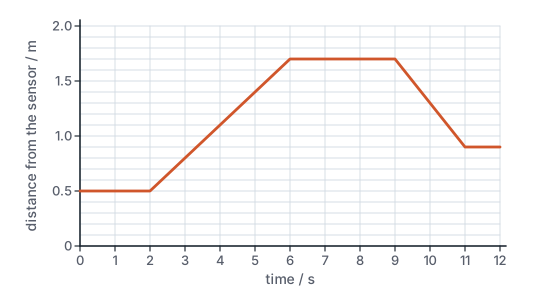
The graph shows a toy car's distance from a motion sensor. (a) Describe the car's motion in each of the five parts. (b) Calculate its speed between 2 s and 6 s. (c) State its velocity and its speed between 9 s and 11 s, taking away from the sensor as positive, and explain why they are different. (d) Calculate the total distance travelled and the average speed for the whole 12 s. (e) On paper, copy the graph and continue it to 18 s: at 12 s the car moves away from the sensor at a steady 0.20 m/s for 3 s, then stays still.
 (enlarge)
Your saved work
Answers and earlier attempts stay in this browser. Export a copy to keep, to move to another device or to hand to your teacher. Importing a copy keeps your current answers and adds earlier attempts.
Scope and sources
Cambridge IGCSE Physics 0625 · 2026–2028 v2 · Original learning materials.
Speed as distance travelled per unit time, v = s/t (1.2.1); velocity as speed in a given direction (1.2.2); average speed = total distance ÷ total time (1.2.3); sketching, plotting and interpreting distance–time and speed–time graphs (1.2.4); at rest, constant speed, speeding up and slowing down from a graph or from data (1.2.5); speed from the gradient of a straight section of a distance–time graph (1.2.6); distance travelled from the area under a speed–time graph for constant speed or constant acceleration (1.2.7). Acceleration as a number, free fall and drag (1.2.8–1.2.13) are in MOT02.
Apparatus, amounts and times in the experiment are illustrative. Real practical work follows a teacher-approved safety method.
Official Cambridge syllabus